Solar Panel Calculator (How Many Panels?)
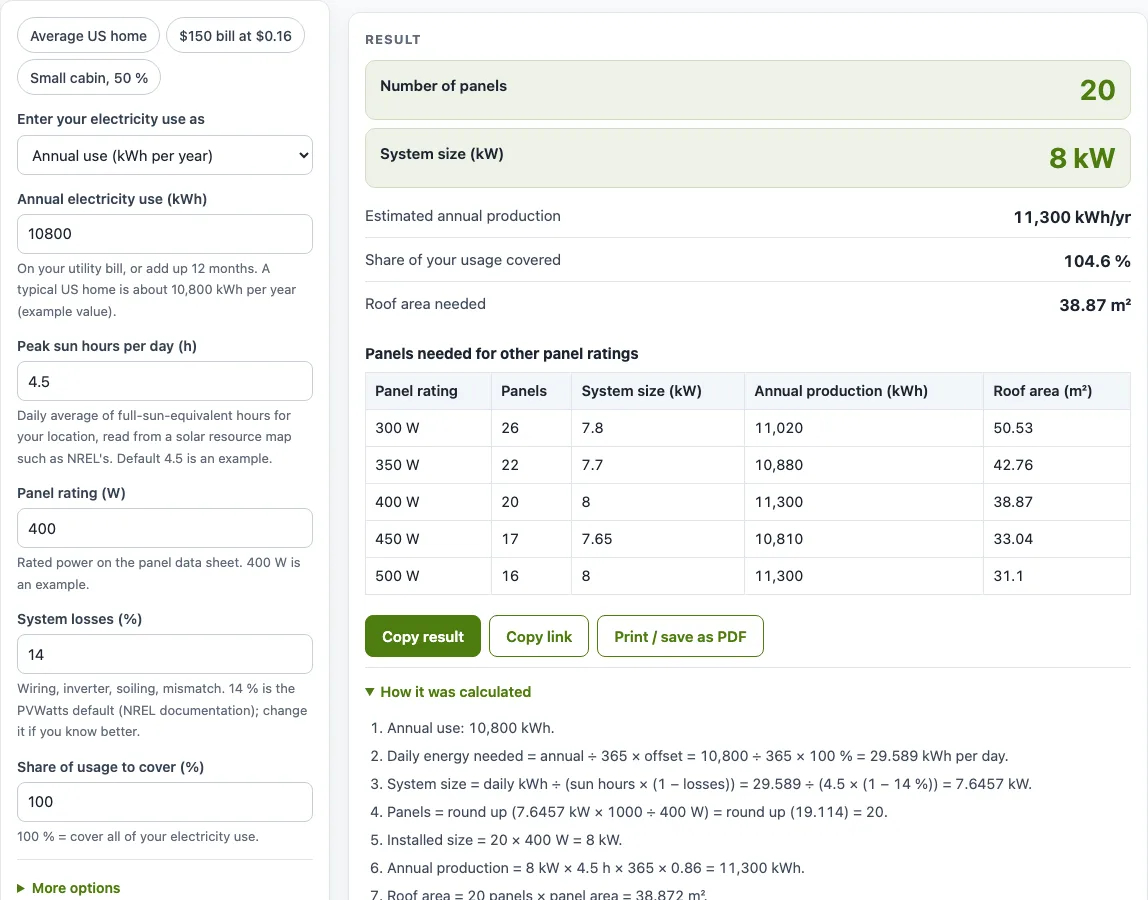
Enter your electricity use, peak sun hours and panel wattage to get the system size, the number of solar panels and the yearly output.
Popular tools
- How Many kWh Does a House Use? (Calculator)Enter the kWh on your bill, or a year's total, to see your kWh per day, month and year next to the U.S. average home.
- Solar Panel Angle Calculator (Tilt)Enter your latitude to get the best solar panel tilt angle for the whole year, each season or a chosen date.
This solar calculator estimates how many solar panels you need and what system size in kW will cover your electricity use. Enter your usage as yearly kWh, monthly kWh, or a bill with its price per kWh, then add your local peak sun hours and panel rating. It returns the panel count, system size, estimated annual production and roof area. It runs in your browser, is free, needs no sign-up, and uploads nothing.
The result is a sizing estimate, not a final design. Use it as a starting point for planning, for comparing panel ratings, or for checking an installer’s proposal. You can also size a system to cover only part of your use.
How to use the solar calculator
- Set Enter your electricity use as to Annual use (kWh per year), Monthly use (kWh per month), or Monthly bill and price per kWh.
- Fill in the field that appears: Annual electricity use (kWh), Monthly electricity use (kWh), or Average monthly bill with Price per kWh. In bill mode, enter only the energy part of the bill if you can, because fixed charges are not energy.
- Enter Peak sun hours per day (h) for your location. Read it from a solar resource map such as NREL’s.
- Enter Panel rating (W) from your panel’s data sheet.
- Check System losses (%) and Inverter efficiency (%). The defaults are NREL PVWatts’ 14 % and 96 %.
- Set Share of usage to cover (%). Use 100 % to cover all of your use.
- Optional: open More options, choose Panel size unit, then enter Panel length and Panel width from your module’s data sheet. Clear both fields to skip the roof area.
- Read the results: Number of panels, System size (kW), Estimated annual production, Share of your usage covered, and Roof area needed.
The buttons above the form load example inputs: Average US home, $150 bill at $0.16, and Small cabin at 50 %. Below the result, “How it was calculated” shows every step with your numbers. Copy result copies the result lines and a link, Copy link saves your inputs in the page address, and Print / save as PDF produces a file with inputs, results, steps and the date. Reset restores the starting example.
How many solar panels do I need?
You need enough panels that their combined rated power reaches the system size your usage requires. The calculator divides the system size in watts by the panel rating and rounds the result up to a whole panel. In the example, a 7.96 kW need with 400 W panels gives 7,958 ÷ 400 = 19.9, so 20 panels are needed, which is an 8 kW system.
How do I calculate solar system size?
System size in kilowatts equals the daily energy you need divided by the energy each kilowatt of panels delivers per day. The formula is: system size (kW) = daily energy to cover (kWh) ÷ (peak sun hours × (1 − system losses) × inverter efficiency). Daily energy is your annual kWh divided by 365, or your monthly kWh divided by roughly 30.
Using the example: 10,791 ÷ 365 = 29.56 kWh per day, and 4.5 × (1 − 0.14) × 0.96 = 3.715. Then 29.56 ÷ 3.715 = 7.96 kW. The 14 % is NREL PVWatts’ default for soiling, shading, mismatch, wiring, connections, light-induced degradation, nameplate rating and availability; PVWatts counts the inverter separately at 96 %, and so does this calculator.
In bill mode, the calculator first finds your monthly kWh: monthly bill ÷ price per kWh. A $150 bill at $0.16 per kWh is 150 ÷ 0.16 = 937.5 kWh per month.
What are peak sun hours?
Peak sun hours are the number of hours per day that equal full sun, meaning 1,000 W per square metre of sunlight. Four and a half peak sun hours deliver the same energy as four and a half hours of full sun, even if the sun is up for longer. The value is a daily average for your location and panel tilt. Values vary widely by region and season, so check a solar resource map such as NREL’s. The calculator asks you to double-check values below 2 or above 8 hours.
How much roof space do solar panels need?
Roof area is the number of panels multiplied by the area of one panel. The default panel size of 1.722 × 1.134 m is the CertainTeed CTM10400HC11-06 400 W module, used only as an example, so use the dimensions on your own module’s data sheet. For 20 of those panels, the area is 20 × 1.953 m² = 39.1 m². The calculator counts only the panel face area, not the gaps or clearances an installer may need.
How many solar panels to power a house?
The number depends on the house’s yearly use, the peak sun hours at its location, and the panel rating. The U.S. Energy Information Administration puts the average American home at 10,791 kWh of electricity a year (2022), which needs about 20 panels of 400 W at 4.5 sun hours. A smaller home needs fewer. For example, covering half of 3,000 kWh per year at 5 sun hours with 400 W panels needs 3 panels, a 1.2 kW system.
Solar estimator, PV calculator or production estimate?
People call this tool many things: a solar PV calculator, a PV panel calculator or solar PV panel calculator, a photovoltaic panels calculator or solar photovoltaic calculator, a solar power estimator, a solar energy estimator, a solar installation calculator, a solar electric system calculator, even a solar cell calculator. They all start from the same calculation of a solar system: energy you use, sun you get, losses, then panel count. Calculating solar production is the same arithmetic in reverse, as the yearly production row shows. For an hour-by-hour simulation at your exact address, NREL’s PVWatts (often searched as “pv watts”) models weather and orientation in detail; this solar PV calc is the quick estimate you can check by hand, and the solar PV estimator figures it gives should land close to such a model when the sun hours and losses match.
Worked examples
| Input | Result |
|---|---|
| 10791 kWh/yr, 4.5 sun hours, 400 W panels, 14 % losses, 96 % inverter | 20 panels, 8 kW, about 10,850 kWh per year |
| 150 / 0.16 per kWh, 4.5 sun hours, 400 W panels, 14 % losses, 96 % inverter | 21 panels, 8.4 kW, about 11,390 kWh per year |
| 3000 kWh/yr, 5 sun hours, 400 W panels, 14 % losses, 96 % inverter | 3 panels, 1.2 kW, about 1,808 kWh per year |
| 650 kWh/mo, 5.5 sun hours, 430 W panels, 16 % losses, 96 % inverter | 12 panels, 5.16 kW, about 8,353 kWh per year |
| 14000 kWh/yr, 3.5 sun hours, 500 W panels, 14 % losses, 96 % inverter | 27 panels, 13.5 kW, about 14,240 kWh per year |
Calculated by the tool above with these values.
Frequently asked questions
Is the result exact?
No. The calculator gives a sizing estimate using a simple formula. For hour-by-hour production at your site, use a detailed model such as NREL’s PVWatts, and have the final design checked by an installer.
What if my peak sun hours value is outside 2 to 8?
The calculator asks you to double-check it, but it still calculates. Check the value on a solar resource map for your exact location and tilt.
Why does the result show more than 100 % of my usage?
Covering more than 100 % oversizes the system for your own consumption. That only pays off if your utility credits the electricity you export.
Can I size a system for part of my electricity use?
Yes. Set Share of usage to cover (%) below 100 %. The panel count and system size then cover only that share of your use.
Can I change the default 14 % system losses?
Yes. The 14 % default is the PVWatts default. Change it if you know your system’s losses better. The calculator warns you if the value falls outside the usual 5 to 30 % range.
Can I use the results in a quote or report?
Yes. Results, charts and printouts can be used freely in commercial work such as quotes, proposals, reports and service records, with no attribution needed. The calculator also notes that results are for estimation, so verify critical designs against the applicable standard.
Is my data uploaded anywhere?
No. Everything runs in your browser, and nothing is uploaded.
Related tools
- Solar panel output calculator: use it to estimate how much energy a single panel or array produces.
- Solar panel angle calculator: use it to find a tilt angle for your panels.
- Solar battery size calculator: use it when you plan to store solar energy for later use.
- Inverter size calculator: use it to match an inverter to your panel array.
- Solar charge controller calculator: use it to size a controller for a battery charging setup.
- Solar wire size calculator: use it to choose wire gauge for your solar circuits.
- All solar and battery calculators: browse every calculator on the site.
Sources
- EIA, How much electricity does an American home use?: 10,791 kWh a year in 2022
- NREL PVWatts Version 5 Manual (Dobos 2014, NREL/TP-6A20-62641) — default system losses 14 % and inverter efficiency 96 %, summarised by Aurora Solar
- CertainTeed CTM10400HC11-06 data sheet: example 400 W module (Voc 37.04 V, Isc 13.79 A, Vmp 31.01 V, −0.27 %/°C Voc, 1722 × 1134 mm)