Battery Runtime Calculator
Enter the battery capacity and the load to see how many hours it will run, for lead-acid, AGM, lithium or UPS batteries.
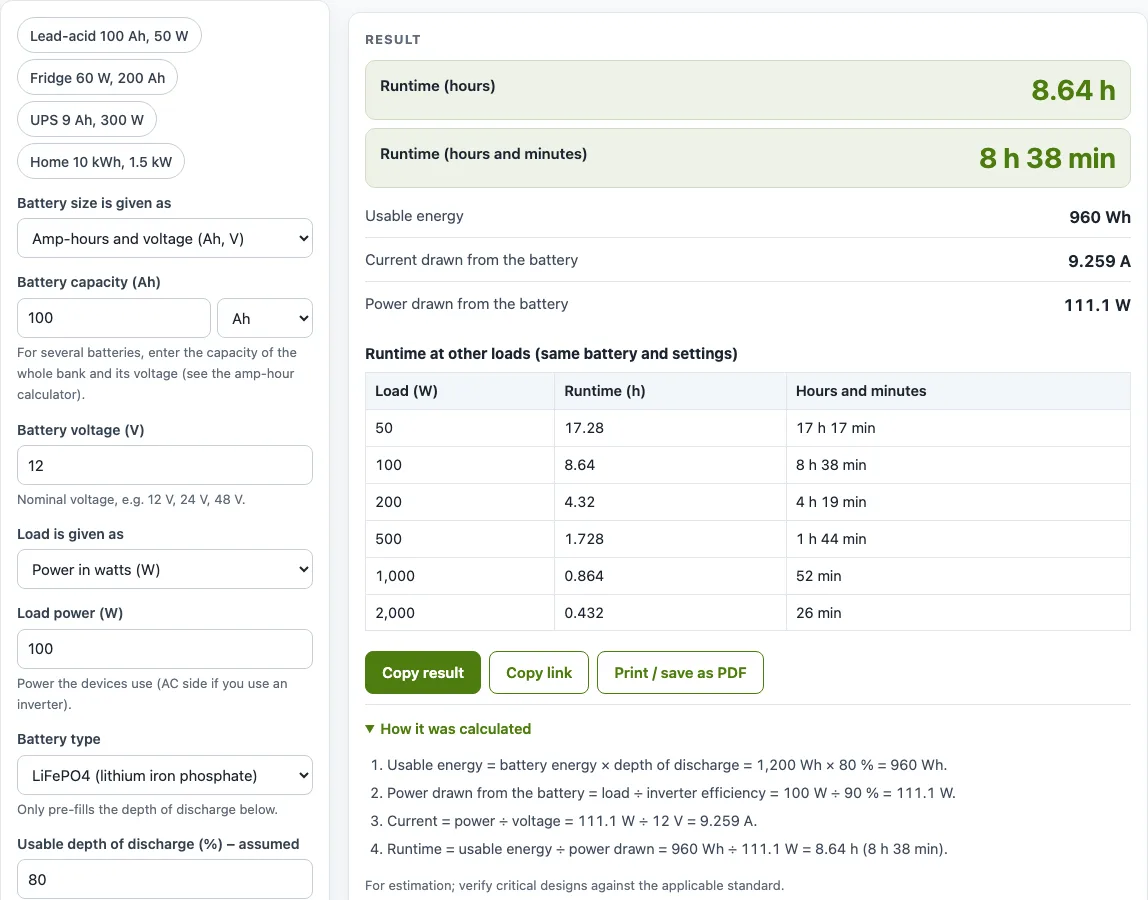
How to use the Battery runtime calculator
- Under Battery size is given as, choose Amp-hours and voltage (Ah, V) or Energy (Wh or kWh).
- If you chose Ah and V, enter the Battery capacity (Ah) in Ah or mAh. For several batteries, enter the capacity of the whole bank.
- Enter the Battery voltage (V), using the nominal voltage such as 12 V, 24 V or 48 V. If you chose energy, enter the Battery energy (Wh) in Wh or kWh instead.
- Under Load is given as, choose Power in watts (W) or Current in amps at battery voltage (A). Then fill in Load power (W) or Load current (A).
- Choose the Battery type. This pre-fills the depth of discharge.
- Check Usable depth of discharge (%). Change it to match your battery’s rating, or leave it blank to use the pre-filled value.
- If the load is wired straight to the battery, tick DC load, no inverter. Otherwise, set the Inverter efficiency (%). The default is 90 %, from Victron’s Phoenix data sheet.
- For lead-acid batteries, you can open More options and enter the Peukert exponent (k) and the rated discharge time (h) from the data sheet.
- Read the results: Runtime (hours), Runtime (hours and minutes), and any other rows shown for your mode.
Copy result copies the result lines with a link, Copy link saves every input in the page address, and Print / save as PDF produces a copy with your inputs, results, steps and the date. Reset restores the starting example.
How do you calculate battery runtime?
Divide the usable energy in the battery by the load. In formula form, runtime (h) = capacity (Wh) × usable depth of discharge × inverter efficiency ÷ load (W).
Start with the capacity in watt-hours. If you know amp-hours, multiply by the voltage: a 12 V, 100 Ah battery holds 12 × 100 = 1,200 Wh. The depth of discharge is the share of that energy you can safely use. The calculator pre-fills 50 % for lead-acid, AGM and gel batteries (Trojan recommends discharges of 50 % or less) and 80 % for LiFePO4 and Li-ion (the lower end of Renogy’s 80–100 %). Inverter efficiency is the share that makes it through the inverter to your devices, pre-filled at 90 % from Victron’s Phoenix data sheet. For a load wired directly to the battery, tick DC load to skip the inverter step.
The load must be in watts, and the energy in watt-hours, so the units match. Watt-hours divided by watts gives hours.
Lead-acid batteries deliver less usable energy at higher currents. Peukert’s law corrects for this: t = H × (C ÷ (I × H))^k, where H is the rated discharge time (for example the 20-hour rate on Trojan’s data sheets), C is the capacity at that rate, I is the current drawn, and k is the exponent from the maker’s data sheet. The field is optional and stays off unless you enter k.
How long will a 100Ah battery run a 100W load?
A 12 V, 100 Ah LiFePO4 battery at 80 % depth of discharge, with a 90 % inverter, runs a 100 W load for about 8.64 hours, or 8 h 38 min. A lead-acid battery at 50 % gives about 5.4 hours for the same load and inverter.
For the LiFePO4 case, 1,200 Wh × 0.80 = 960 Wh, then 960 Wh × 0.90 = 864 Wh, and 864 Wh ÷ 100 W = 8.64 h. Halving the load to 50 W doubles the runtime to 17.28 hours. The lead-acid battery at 50 % depth of discharge runs the same 50 W load for 1,200 × 0.5 × 0.9 ÷ 50 = 10.8 hours.
Worked examples
| Input | Result |
|---|---|
| 100 Ah at 12 V, 100 W | 8.64 h (8 h 38 min) |
| 100 Ah at 12 V, 50 W | 10.8 h (10 h 48 min) |
| 200 Ah at 12 V, 60 W | 32 h (32 h 0 min) |
| 18 Ah at 12 V, 300 W | 0.324 h (19 min) |
| 10 kWh, 1500 W | 4.8 h (4 h 48 min) |
| 100 Ah at 12 V, 120 W | 8.706 h (8 h 42 min) |
Calculated by the tool above with these values.
Frequently asked questions
How long will a battery last?
Runtime depends on the battery’s usable energy and the load. The calculator answers how many hours a given battery runs a given load, so enter your load to get that figure. Battery service life in years is a separate question that the calculator does not answer.
How do I calculate UPS runtime?
Use battery Wh × usable fraction × inverter efficiency ÷ load. For example, an 18 Ah, 12 V battery holds 216 Wh; at 50 % usable and 90 % efficiency, a 300 W load gives 0.324 h, or 19 minutes.
Can I use the calculator for several batteries?
Yes. Enter the capacity of the whole bank in Ah and its voltage, such as 12 V or 24 V, so the total energy is counted. The amp-hour calculator can help you work out the bank’s capacity first.
Why does a warning mention Peukert’s law?
Peukert’s law is normally used for lead-acid batteries. For other types, use the maker’s discharge curves for accurate runtime.
What does the C-rate warning mean?
It appears when the current drawn is above 1C, which means the current is more than the battery’s amp-hour rating. Check the maximum discharge current in the battery’s data sheet before relying on the result.
Are the results exact?
They are estimates, based on the assumed depth of discharge and inverter efficiency. Replace the assumptions with your battery’s and inverter’s data sheet values, and verify critical designs against the applicable standard.
Related tools
- Amp hour calculator: use it to work out the amp-hours of a battery or bank before you enter it here.
- Solar battery size calculator: use it to size a battery for a solar system’s daily energy needs.
- Battery charging time calculator: use it to estimate how long a battery takes to recharge.
- Inverter size calculator: use it to choose an inverter rated for your total load.
- mAh to Wh converter: use it to convert a capacity in mAh to watt-hours for the energy field.
- Battery voltage chart: use it to check the nominal and typical voltage of a battery type.
- All solar and battery calculators: use it to browse every calculator on the site.
Sources
- Trojan Battery, Battery maintenance: “50% (or less) discharges are recommended”
- Renogy, What is depth of discharge: 80–100 % for lithium
- Victron Phoenix Inverter VE.Direct data sheet: maximum efficiency (90 % pre-fill)
- Trojan Battery T-1275 data sheet: 20-hour rated capacity