12V Car Battery Voltage Chart (State of Charge)
Read a battery's state of charge from its resting voltage, or see the full chart for 6, 12, 24 or 48 V, using each battery maker's own table.
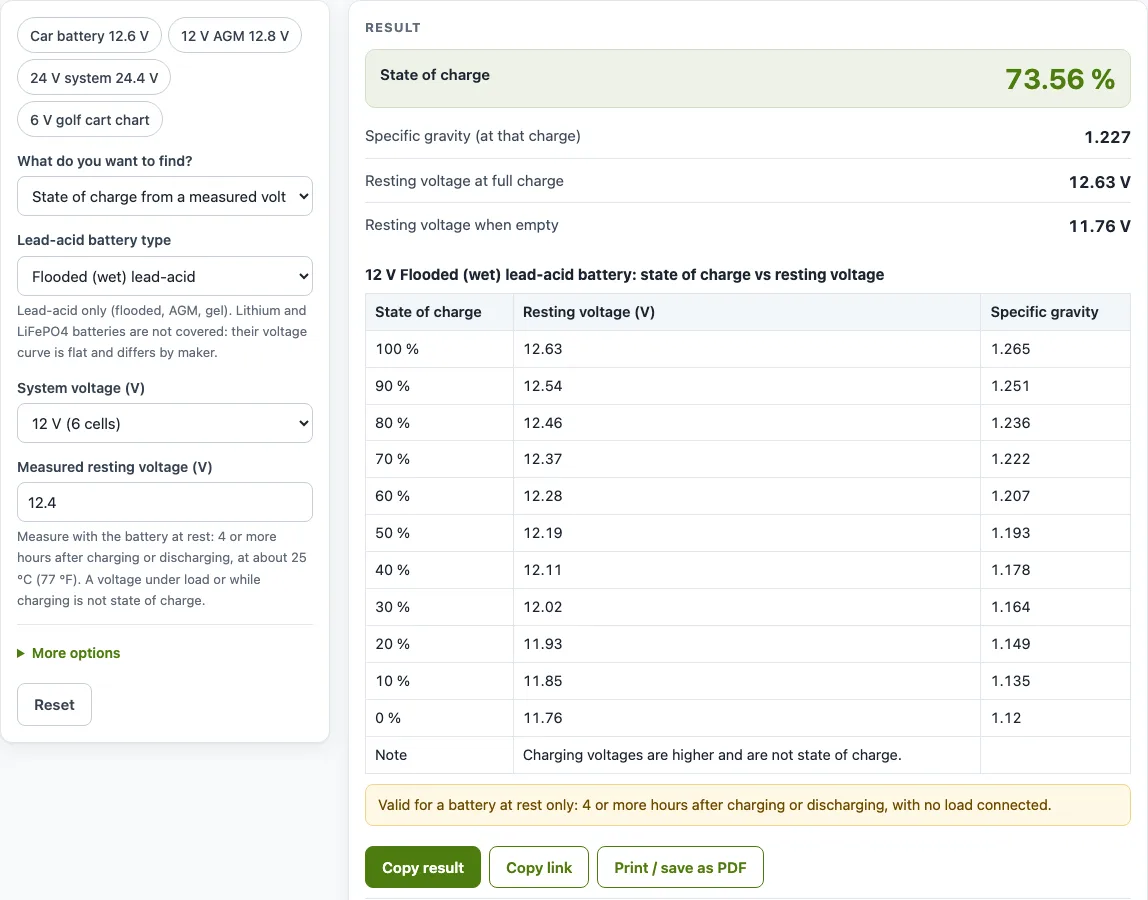
How to use the Battery Voltage Chart
- Open What do you want to find? and choose State of charge from a measured voltage, Resting voltage for a state of charge, or Just the chart.
- Set Battery type: flooded lead-acid (Trojan table), AGM or gel (Discover Battery table), or LiFePO4 (Renogy table).
- Pick System voltage (V): 6 V, 12 V, 24 V or 48 V. The LiFePO4 table has no 6 V column, so use 12, 24 or 48 V for lithium.
- If shown, enter Measured resting voltage (V). Measure with nothing connected after the battery has rested: Trojan asks for at least 6 hours, preferably 24, and Discover Battery for 24 hours.
- If shown, enter State of charge (%) to get the resting voltage for that level.
- Optional: open More options to add a Battery temperature note. No temperature correction is applied.
- Read the result rows and any warning, then check the table below the result, which lists every row of the maker’s table for your system voltage.
To try the tool quickly, use the example buttons above the form: Car battery 12.6 V, 12 V AGM 12.5 V, 12 V LiFePO4 13.25 V, or 6 V golf cart chart. Below the result, Copy result copies the result lines with a link, Copy link stores every input in the page address so the calculation reopens later, and Print / save as PDF prints the inputs, results, steps and date. Reset returns to the starting example.
What voltage should a car battery read?
A fully charged flooded 12 V battery at rest reads about 12.73 V in Trojan’s table, which lists 2.122 V per cell and a specific gravity of 1.277 at 100 %. The table falls to 12.10 V at 50 % and 11.51 V at 10 %, its lowest row. Between two rows the calculator draws a straight line, so a reading of 12.4 V, which sits between the 70 % row (12.37 V) and the 80 % row (12.50 V), shows as about 72 %. A reading of 12.6 V shows as about 88.5 %.
AGM and gel batteries rest a little higher. Discover Battery’s table puts a 12 V AGM battery above 12.80 V when full, 12.30 V at 50 % and below 11.80 V when empty; a gel battery reads above 12.85 V when full. A 12.5 V AGM reading is therefore about 67 %.
For other lead-acid systems the chart multiplies the cell voltage by the number of cells: a 6 V golf cart battery (3 cells) is about 6.37 V full, and a 24 V flooded bank reading 24.4 V is about 57 %.
LiFePO4 battery voltage chart
Renogy’s chart gives a 12 V LiFePO4 battery 13.6 V at rest when full, 13.0 V at 50 %, 12.0 V at 10 % and 10.0 V at 0 %, with matching 24 V and 48 V columns. The 14.6 V figure often quoted for LiFePO4 is the charging voltage, not a resting one, so it is left out. The curve is very flat: 13.0 V appears at both 40 % and 50 %, so the calculator shows the middle and warns that the true value lies anywhere in that range. A shunt-type battery monitor gives a much better reading for lithium.
Why voltage only shows charge at rest
While a battery is charging, the charger pushes the voltage above the resting value; under load it sags below it. Both effects fade with time, which is why the makers ask for a rest period before the reading is compared with their table.
Worked examples
| Input | Result |
|---|---|
| 12.4 V, 12 V Flooded (wet) lead-acid – Trojan table | 72.2 % |
| 12.6 V, 12 V Flooded (wet) lead-acid – Trojan table | 88.5 % |
| 12.5 V, 12 V AGM – Discover Battery table | 66.7 % |
| 13.25 V, 12 V LiFePO4 (lithium iron phosphate) – Renogy table | 75 % |
| 24.4 V, 24 V Flooded (wet) lead-acid – Trojan table | 57.1 % |
| 50 %, 12 V Flooded (wet) lead-acid – Trojan table | 12.1 V |
| 6 V Flooded (wet) lead-acid – Trojan table | 6.366 V at 100 %, 5.754 V at 10 % |
Calculated by the tool above with these values.
Frequently asked questions
What is a fully charged 12V battery voltage?
At rest, about 12.73 V for a flooded battery (Trojan), above 12.80 V for AGM and above 12.85 V for gel (Discover Battery), and 13.6 V for LiFePO4 (Renogy).
At what voltage is a 12V battery dead?
Trojan’s flooded table stops at 11.51 V for 10 %, and Discover Battery lists below 11.80 V as 0 % for AGM and gel. The calculator shows readings below the lowest row as that row. This is a state-of-charge figure, not a test of whether a battery can still start a car.
How do you check a car battery’s state of charge?
Turn the engine and all loads off, let the battery rest (24 hours is best), and measure across the terminals with a multimeter. Enter that reading in the Measured resting voltage field. Trojan notes that a hydrometer reading of specific gravity is the more accurate check for flooded batteries.
Why does my battery read higher right after charging?
A battery that was just charged has a higher surface voltage. Let it rest before measuring, and the reading will match the maker’s resting table.
Can I use this chart for a LiFePO4 or lithium battery?
Yes for LiFePO4, using Renogy’s published table, but treat it as a rough guide because the voltage hardly changes over most of the charge range and differs between makers. Your own battery maker’s chart takes precedence. Other lithium chemistries are not covered.
Related tools
- Battery runtime calculator: use it to estimate how long a battery can power your devices.
- Battery charging time calculator: use it to estimate how long a battery takes to recharge.
- Amp hour calculator: use it to work out the amp-hour capacity a battery needs for your load.
- Solar battery size calculator: use it to size a battery bank for a solar system.
- Inverter size calculator: use it to choose an inverter that matches your battery and load.
- All solar and battery calculators: use it to browse every calculator on the site.
Sources
- Trojan Battery T-1275 data sheet: state of charge, specific gravity and open-circuit voltage table; Trojan FAQ on hydrometer readings
- Discover Battery, How can you tell if a battery is fully charged?: Table 5, AGM and gel open-circuit voltage
- Renogy, LiFePO4 voltage chart: 12 V, 24 V and 48 V resting voltages