Inverter Size Calculator
List the appliances you will run to get the inverter size in watts, the surge it must handle and the battery current.
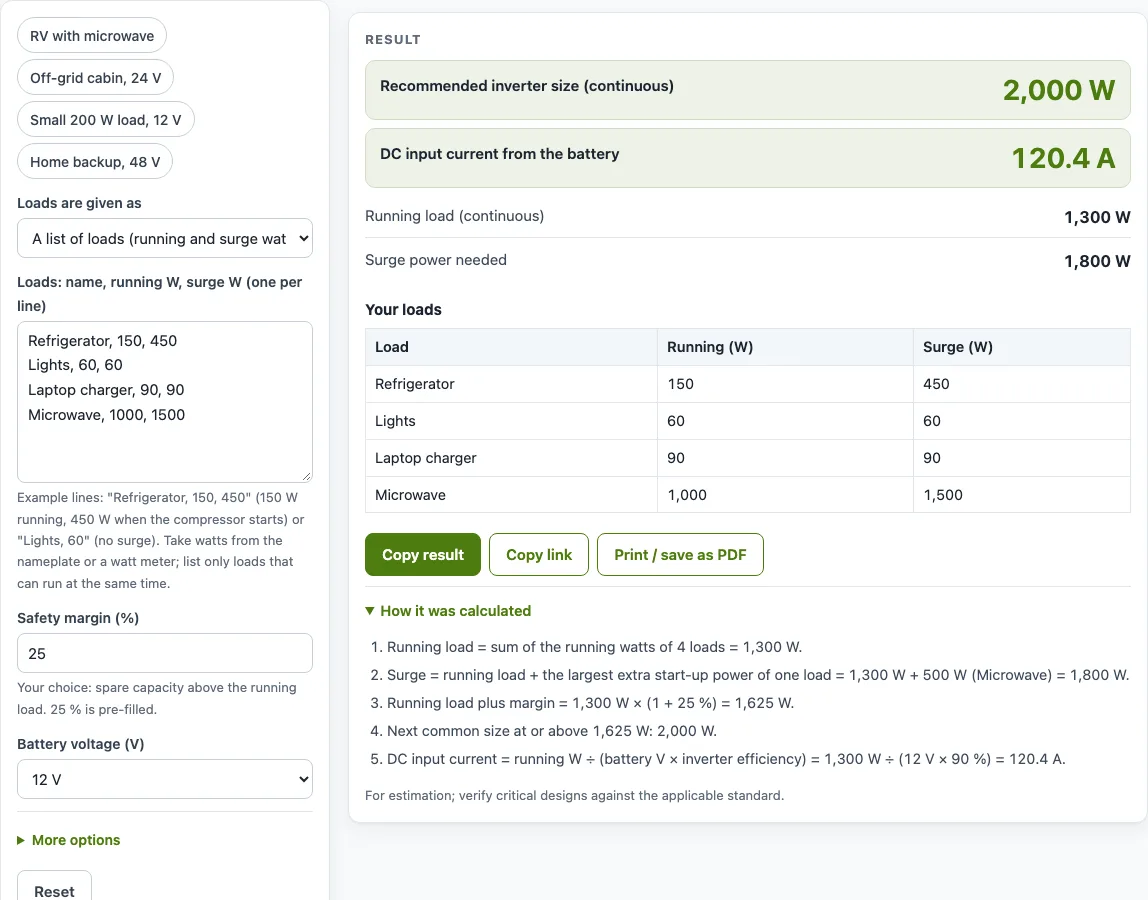
How to use the Inverter Size Calculator
- Open the “Loads are given as” drop-down and choose either “A list of loads (running and surge watts)” or “A total (running and surge watts)”.
- For a list, enter one load per line in “Loads: name, running W, surge W”, for example “Refrigerator, 400, 1200”. For a load with no surge, leave out the third value, as in “Lights, 60”. Take watts from the nameplate or a watt meter, and list only loads that can run at the same time.
- For a total, type your figures into “Total running power (W)” and “Total surge power (W)”. Leave the surge box blank if the loads have no surge.
- Check “Safety margin (%)”. It is pre-filled at 25 %, and you can change it to the spare capacity you want.
- Pick “Battery voltage (V)”: 12 V, 24 V or 48 V.
- Under “More options”, check “Inverter efficiency (%) – assumed” (90 % by default; use your inverter’s data sheet). If you have the figure, enter “Inverter surge rating (W) – optional” so the calculator can compare it with your loads.
- Read the results and the “How it was calculated” steps, and note any warnings.
The example buttons above the form fill in the inputs for you. Copy result copies the result lines with a link. Copy link stores every input in the page address, so the same calculation reopens later. Print / save as PDF includes your inputs, results, steps and the date. Reset restores the starting example.
What size inverter do I need?
The inverter must supply the running watts of everything you use at the same time, plus spare capacity. Add the running watts of those loads and multiply by (1 + margin); the result is the minimum continuous rating to look for. Makers sell different size steps, so pick a model rated at least that much. In the default example, a refrigerator (400 W), four LED bulbs (60 W), a laptop (75 W) and a microwave (1,200 W) run at 1,735 W; with a 25 % margin the inverter should be rated at least 2,169 W. The example watts come from Champion Power Equipment’s and Generac’s published wattage charts, so replace them with your own nameplates.
How do I calculate inverter size?
Work in three steps. First, add the running watts of the loads that run together. Second, multiply that total by (1 + margin); with a 25 % margin, multiply by 1.25. Third, pick an inverter whose continuous rating is at least the result. Then check surge separately: take the running total, add the largest single (surge − running) value for one motor load started at a time, and compare the result with the inverter’s surge rating. For example, the cabin list of 1,335 W running with a 25 % margin needs at least 1,669 W.
What is inverter surge power?
Surge power is the short burst of extra power an inverter must deliver when a load starts, which is most often a motor or compressor. Champion’s wattage chart, for example, lists a refrigerator at up to 400 W running and up to 1,200 W starting. Loads that start together add up at start-up, so the calculator adds only the largest single start-up extra to the running total. If the surge needed is higher than the inverter’s surge rating, the Surge check shows a warning. You can avoid this by starting the large loads one at a time or by choosing a larger inverter.
How many amps does an inverter draw from the battery?
Divide the running watts by the battery voltage times the inverter efficiency: DC amps = W ÷ (V × efficiency). With 90 % efficiency (the pre-fill, taken from Victron’s Phoenix inverter data sheet), 1,735 W at 12 V draws about 160.6 A. The same load at 24 V draws about half that current, and at 48 V about a quarter, which is one reason to run a large inverter from 24 V or 48 V. When the current is high, use correctly sized cable and fusing for it, or a higher battery voltage.
Worked examples
| Input | Result |
|---|---|
| 1,735 W running, 2,535 W surge, 25 % margin, 12 V | 2,168.8 W inverter, 160.6 A DC |
| 1,335 W running, 2,135 W surge, 25 % margin, 24 V | 1,668.8 W inverter, 61.81 A DC |
| 200 W, 25 % margin, 12 V | 250 W inverter, 18.52 A DC |
| 4000 W, 25 % margin, 48 V | 5,000 W inverter, 92.59 A DC |
| 1,735 W running, 2,535 W surge, 0 % margin, 12 V | 1,735 W inverter, 160.6 A DC |
Calculated by the tool above with these values.
Frequently asked questions
Do I have to use the 25 % safety margin?
No. The 25 % margin is only the pre-filled default, and you can change it. A 0 % margin leaves no room for a load slightly above its nameplate watts, so the 1,735 W example needs an inverter rated at only 1,735 W, with no spare capacity.
What does the warning about the surge rating mean?
It means the inverter cannot supply the start-up power of your loads together. Choose a larger inverter, or start the large loads one at a time.
Do I need to enter the inverter’s surge rating?
No, the field is optional. Enter the figure from the inverter’s data sheet if you want the Surge check to compare it with the surge your loads need.
Can I use the results in a quote or report?
Yes. Results may be used freely in commercial work such as quotes, proposals, reports and service records, with no attribution needed. The note under every result still applies: “For estimation; verify critical designs against the applicable standard.”
Can I run an inverter from a 12 V car battery?
Small inverters, yes, but the current is high: the DC input row shows it. A 300 W load draws about 28 A from 12 V at 90 % efficiency, and a car starting battery is not designed for deep discharge, so use a deep-cycle battery for longer use.
Related tools
- Solar battery size calculator: use it to size the battery bank that feeds the inverter.
- Battery runtime calculator: use it to find out how long a battery will power your loads.
- Solar wire size calculator: use it to choose cable for the battery-side current.
- Solar panel calculator: use it when you are planning the panels that charge the battery.
- Amp hour calculator: use it to convert battery capacity or current into amp-hours.
- All solar and battery calculators: use it when you want the full list of tools.
Sources
- Champion Power Equipment wattage chart and Generac’s generator wattage worksheet: running and starting watts of the example loads
- Victron Phoenix Inverter VE.Direct data sheet: maximum efficiency (90 % pre-fill)