kWh Calculator (Watts to Kilowatt-Hours)
Enter the power of a device and how long it runs to get the energy in kWh and Wh per day, month and year.
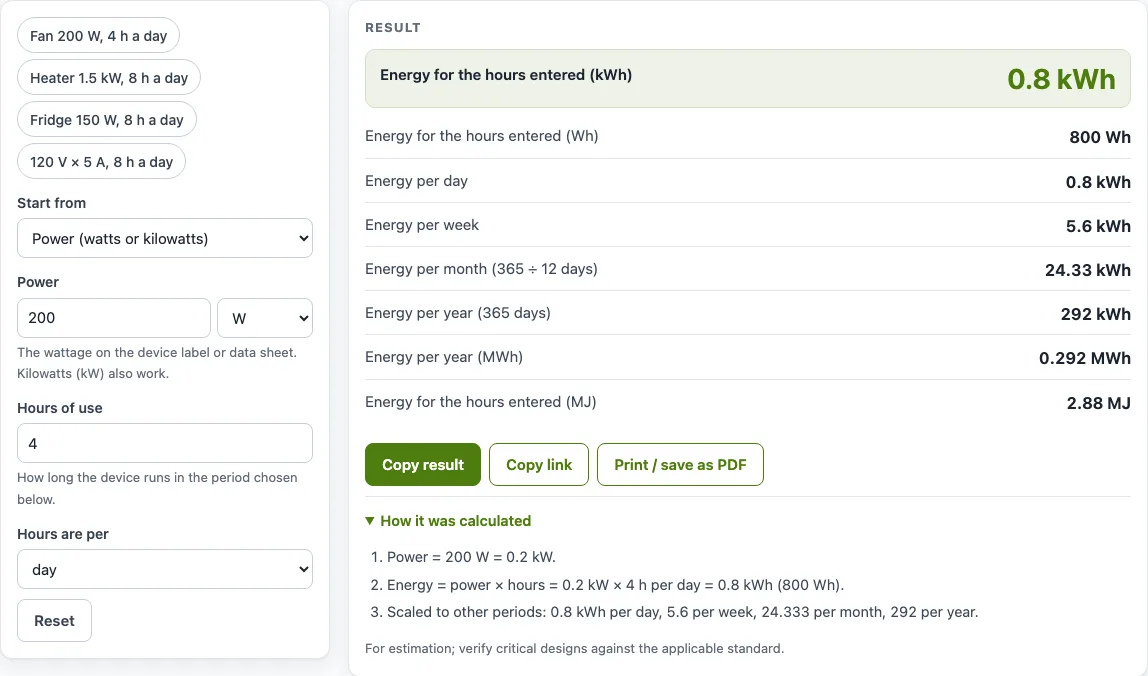
How to use the kWh calculator
- Open the Start from drop-down and choose Power (watts or kilowatts) or Volts and amps.
- If you chose power, type the wattage into Power and select W or kW as the unit. The wattage is usually printed on the device label or in its data sheet.
- If you chose volts and amps, enter the Voltage (V) and Current (A). The calculator multiplies them to get power.
- For AC loads only, enter a Power factor – optional between 0 and 1. Leave it blank for DC loads or to use 1.
- Type the run time into Hours of use.
- Open Hours are per and choose day, week, month or year to match the number you entered.
- Read the result rows. Only the rows that apply to your chosen mode appear. Scroll to How it was calculated to check each step with your numbers.
If you want a quick start, press one of the example buttons, such as Fan 200 W or Heater 1.5 kW, to fill in the form with a sample.
Use Copy result to copy the result lines with a link, or Copy link to save the page address, which stores every input so the same calculation reopens later. Print / save as PDF gives you the inputs, results, steps and date. Reset returns the form to the starting example.
How do you calculate kWh?
Energy in kilowatt-hours equals power in kilowatts multiplied by hours of use. To convert watts to kWh, divide the watts by 1,000 to get kilowatts, then multiply by the hours. Virginia Cooperative Extension (Virginia Tech) gives the same method for appliances: wattage × hours used per day ÷ 1000 = daily kWh.
Take a 200 W fan running 4 hours a day. 200 × 4 = 800 Wh, and 800 ÷ 1000 = 0.8 kWh per day. Over a year, 0.8 × 365 = 292 kWh.
For a device rated in volts and amps, first find the power. Power in watts is V × A. For AC loads, multiply by the power factor as well: real power = V × A × PF. Take 120 V × 5 A × 0.9 power factor. That gives 540 W. Running it for 8 hours a day gives 4,320 Wh, or 4.32 kWh per day, and about 1,577 kWh per year.
Because the result is energy, not power, the same device can use very different amounts depending on how long it runs. A 1,000 W heater on for 30 minutes uses 0.5 kWh, and the same heater on for 5 hours uses 5 kWh.
What is a kilowatt hour?
A kilowatt hour (kWh) is the energy used by a load drawing 1,000 watts for one hour. It is built from the watt-hour (Wh), which is one watt for one hour, so 1 kWh = 1,000 Wh. A 60 W bulb running for one hour uses 60 Wh, which is 0.06 kWh.
Energy is also measured in joules. One kWh equals 3.6 megajoules, or 3,600,000 joules, exactly, according to NIST SP 811. That makes the MJ result useful if you work with joules in other calculations.
Longer periods are scaled from the daily figure. The calculator treats a month as 365 ÷ 12 days and a year as 365 days. A 1.5 kW heater running 2 hours a day uses 3 kWh per day, or 1,095 kWh per year.
Worked examples
| Input | Result |
|---|---|
| 200 W, 4 h per day | 0.8 kWh per day, 292 kWh per year |
| 1.5 kW, 2 h per day | 3 kWh per day, 1,095 kWh per year |
| 100 W, 24 h per day | 2.4 kWh per day, 876 kWh per year |
| 120 V × 5 A × PF 0.9, 8 h per day | 4.32 kWh per day, 1,577 kWh per year |
Calculated by the tool above with these values.
Frequently asked questions
How many kWh does a 100 watt device use in a day?
A 100 W device running 24 hours a day uses 2.4 kWh per day, which is 876 kWh per year. For a different run time, multiply 0.1 kW by the hours of use.
How do you convert watts to kWh?
Divide the watts by 1,000, then multiply by the hours of use. For example, a 500 W device running for 3 hours uses 0.5 × 3 = 1.5 kWh.
Does this calculator show the cost of electricity?
No. The calculator gives energy only. To find the cost, you need your price per kWh, which the electricity cost calculator handles.
How much electricity does an average U.S. home use?
The average U.S. home used 10,791 kWh in 2022, about 899 kWh a month, according to the U.S. EIA FAQ. Treat this as a rough comparison for your own totals.
What does the power factor do?
For AC loads, the power factor adjusts volts × amps to show the real power being used. Enter a value between 0 and 1, or leave the field blank to use 1.
Can I use the results in quotes or reports?
Yes. Results can be used freely in commercial work such as quotes, proposals, reports and service records, with no attribution needed. The results are for estimation, so verify critical designs against the applicable standard.
Related tools
- Electricity cost calculator: use it when you have a price per kWh and want to turn energy into a cost.
- MWh to kWh converter: use it when your figure is in megawatt-hours, such as a yearly total for a large site.
- Amp hour calculator: use it when you are working with battery capacity in amp-hours.
- mAh to Wh converter: use it when a battery label lists mAh and you need watt-hours.
- Solar panel output calculator: use it when you want to estimate what a set of panels produces.
- All solar and battery calculators: use it when you want to see the full list of tools.
Sources
- Virginia Cooperative Extension (Virginia Tech), Estimating Appliance and Home Electronic Energy Use, BSE-301NP, 2020: wattage × hours used per day ÷ 1000 = daily kWh; annual cost = annual kWh × rate (example: a 200 W fan, 4 h a day, 120 days = 96 kWh)
- NIST SP 811, Appendix B.8 (energy and heat units): 1 Wh = 3,600 J and 1 kWh = 3.6 MJ (exact), calorie IT 4.1868 J
- EIA, How much electricity does an American home use?: 10,791 kWh a year in 2022