Converter: mAh to Wh (and Wh to mAh)
Enter the battery capacity in mAh and its voltage to get watt-hours, or convert Wh back to mAh.
This mAh to Wh converter turns a battery’s capacity in milliamp hours (mAh) into energy in watt hours (Wh), and it works in reverse too. Enter the capacity and the battery voltage, and the tool gives you the Wh value. Watt hours are the figure airlines use for their limits and the figure many power banks print on their labels, so this conversion helps when you need to compare a battery with a rule or a product spec.
The tool runs in your browser. It is free, needs no sign-up, and does not upload what you enter. A table lists common power bank sizes.
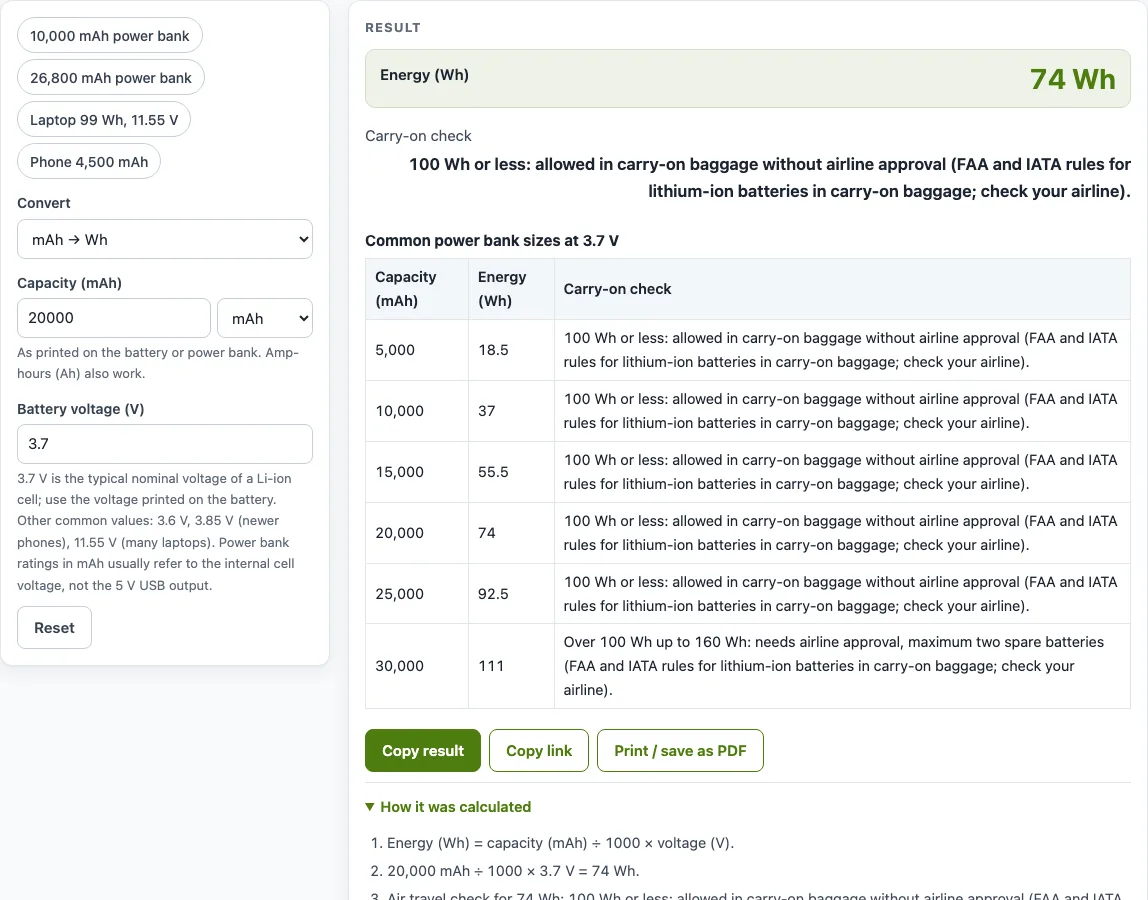
How to use the mAh to Wh converter
- Open the Convert drop-down and choose mAh → Wh to start from capacity, or Wh → mAh to start from energy.
- For mAh → Wh, type the rating into Capacity (mAh), exactly as printed on the battery or power bank. Amp-hours (Ah) also work.
- For Wh → mAh, type the energy into Energy (Wh). You can switch the unit to kWh.
- Enter the Battery voltage (V). Use the nominal voltage printed on the battery or in its specifications, for example 3.7 V.
- Read the result rows. Only the rows that match your mode appear: Energy (Wh), Capacity (mAh), Capacity (Ah), and Carry-on check.
- Open How it was calculated to see the formula and each step with your numbers.
The example buttons above the form (10,000 mAh power bank, 26,800 mAh power bank, Laptop 99 Wh, 11.55 V, and Phone 4,500 mAh) fill the form with sample values so you can see how a result looks.
Copy result copies the result lines and a link. Copy link copies the page address, which stores every input so the same calculation reopens later. Print / save as PDF produces a copy with the inputs, results, steps, and date. Reset returns the form to its starting example.
How do you convert mAh to Wh?
To convert mAh to Wh, multiply the mAh by the battery voltage and divide by 1,000. The formula is Wh = mAh × V ÷ 1,000. To go the other way, use mAh = Wh × 1,000 ÷ V.
For example, a 20,000 mAh power bank at 3.7 V holds 20,000 × 3.7 ÷ 1,000 = 74 Wh. A 10,000 mAh bank at the same voltage holds 37 Wh.
The voltage matters, and it must be the battery’s internal cell voltage. Power bank ratings in mAh refer to the internal cells, whose nominal voltage (for example 3.6 or 3.7 V) is printed on the label. The 5 V on the USB output is a different number. If you use 5 V, the Wh figure comes out too high. The calculator shows a warning when the voltage is near 5 V, and it shows a separate warning when a voltage is unusual for a single battery. When either appears, check the number printed on the battery.
Energy units can also be converted. One kilowatt hour (kWh) equals 1,000 Wh. At 3.7 V, 1 kWh is about 270,270 mAh.
Why is mAh not enough to compare batteries?
mAh measures electric charge, while Wh measures energy. Energy depends on both charge and voltage, so two batteries with the same mAh rating can store very different amounts of energy.
Take two batteries rated at 10,000 mAh. At 3.7 V, one holds 37 Wh. At 11.55 V, the other holds 115.5 Wh. The mAh numbers match, but the energy differs by more than three times.
This is why rules and specifications use Wh. Airline limits for lithium-ion batteries are written in Wh, so a mAh rating alone does not tell you whether a battery is allowed in carry-on luggage. Convert the mAh to Wh with the correct voltage before you compare two products.
Worked examples
| Input | Result |
|---|---|
| 20000 mAh, 3.7 V | 74 Wh |
| 10000 mAh, 3.7 V | 37 Wh |
| 26800 mAh, 3.7 V | 99.16 Wh |
| 99 Wh, 11.55 V | 8,571 mAh |
| 4500 mAh, 3.85 V | 17.33 Wh |
Calculated by the tool above with these values.
Frequently asked questions
How many Wh is a 20,000 mAh power bank?
At 3.7 V, a 20,000 mAh power bank is 74 Wh. A 10,000 mAh bank at the same voltage is 37 Wh. Check the Wh figure printed on the power bank if one is shown.
Can I take a power bank on a plane?
Under FAA PackSafe and IATA guidance for lithium-ion batteries (as of October 2026), up to 100 Wh is allowed in carry-on luggage without airline approval. Batteries from 100 to 160 Wh need airline approval, with at most two spare batteries, and batteries over 160 Wh are not allowed in passenger baggage. Spare batteries must go in carry-on, not checked bags, so check your airline before you fly.
What voltage should I enter for a power bank?
Enter the nominal voltage of the internal cells printed on the label, not the 5 V USB output. Using 5 V overstates the Wh. Look for the voltage on the battery label or in the product specifications.
How do I convert kWh to mAh?
Convert the kWh to Wh by multiplying by 1,000, then divide by the voltage and multiply by 1,000. At 3.7 V, 1 kWh is about 270,270 mAh. Choose Wh → mAh and select kWh in the Energy field to do this in the calculator.
How do I convert Wh to mAh?
Divide the Wh by the voltage and multiply by 1,000. For a 99 Wh laptop battery at 11.55 V, the result is about 8,571 mAh. Choose Wh → mAh in the Convert drop-down to get this result.
Are the results exact?
The results are estimates based on the voltage you enter. The calculator notes that they are for estimation, so verify critical designs against the applicable standard.
Related tools
- Amp hour calculator: Use it when you work with Ah ratings or need to convert between Ah and other battery values.
- Battery runtime calculator: Use it to estimate how long a battery will power a device.
- Battery charging time calculator: Use it to estimate how long it takes to fill a battery.
- Solar battery size calculator: Use it to choose a battery bank for a solar system.
- Inverter size calculator: Use it to pick an inverter that matches your power needs.
- All solar and battery calculators: Use it to browse every calculator on the site.
Sources
- FAA PackSafe, Lithium batteries: 100 Wh limit, two spares up to 160 Wh with airline approval (checked October 2026)
- OpenStax University Physics Vol. 2, ch. 9: current, charge and electrical energy