Solar Battery Bank Size Calculator (Solar Calculator Battery)
Enter your daily energy use and backup days to get the battery bank size in Ah and kWh and how many batteries you need.
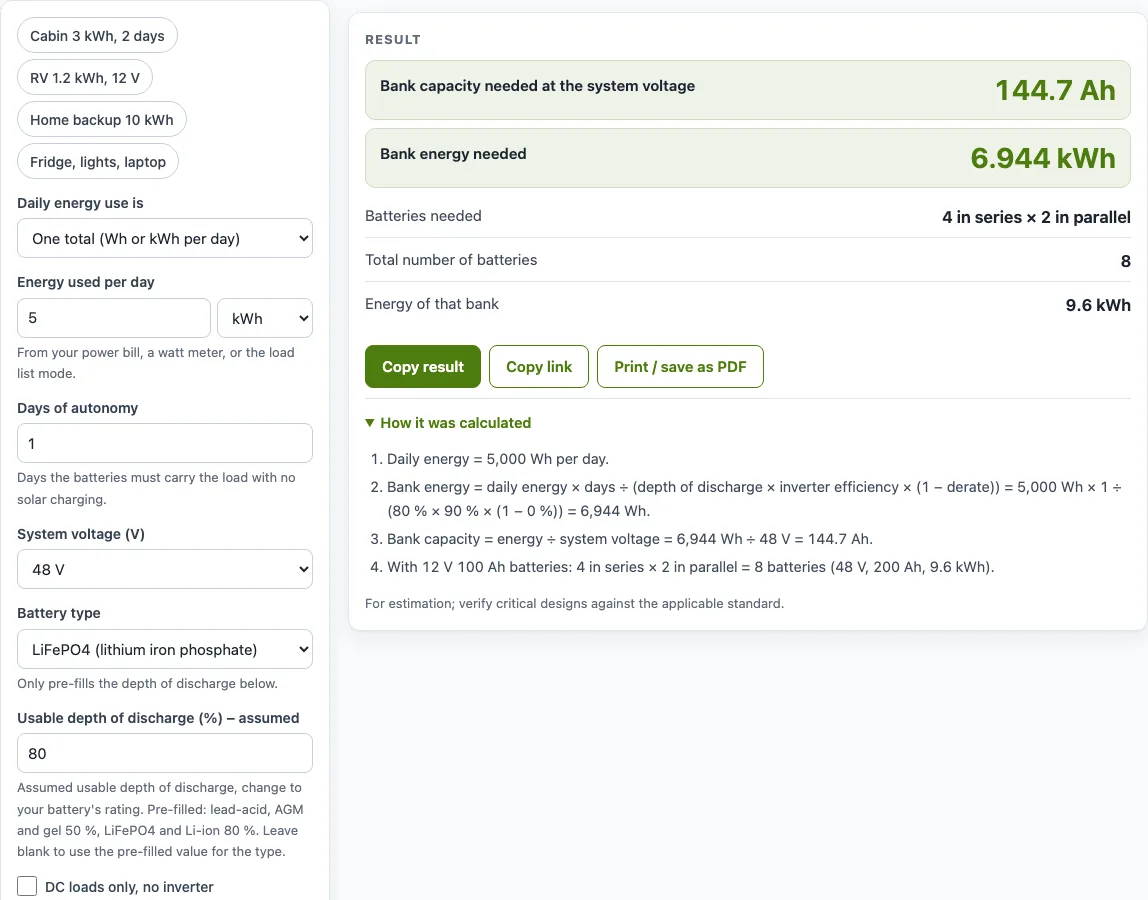
How to use the Solar battery size calculator
- Under “Daily energy use is”, choose One total if you know your daily use, or A list of loads to add up each appliance.
- In total mode, enter your figure in “Energy used per day” in Wh or kWh.
- In list mode, enter each appliance on its own line in “Loads: name, watts, hours per day”, for example
Refrigerator, 400, 8. - Enter “Days of autonomy”: the number of days the batteries must carry the load with no solar charging.
- Choose “System voltage (V)”: 12 V, 24 V or 48 V.
- Choose “Battery type”. This sets the depth of discharge for you.
- Check “Usable depth of discharge (%)”. Change it to your battery’s rating, or leave it blank to use the pre-filled value.
- If you run AC appliances, leave “DC loads only, no inverter” unchecked and confirm “Inverter efficiency (%)” if it appears.
- Under “More options”, enter “Temperature derate (%)” if cold will reduce capacity, and enter “One battery: voltage (V)” and “One battery: capacity (Ah)” to count batteries.
- Read the results and “How it was calculated”.
The example buttons above the form load a complete set of inputs you can change. Use Copy result to copy the result lines with a link, Copy link to save the exact inputs so the calculation reopens later, and Print / save as PDF to keep the inputs, results, steps and date. Reset returns the form to the starting example.
How many batteries do I need for solar?
You need enough battery capacity to hold the energy your loads use across the days without sun, after allowing for the part of the battery you should not drain. The battery count comes from that capacity and the size of each battery. Batteries in series add voltage, and batteries in parallel add amp-hours, so the total is series count × parallel count.
Take 5 kWh a day for 1 day at 48 V, with LiFePO4 at 80 % depth of discharge and 90 % inverter efficiency. That gives 6.94 kWh, or 144.7 Ah at 48 V. With 12 V 100 Ah batteries, you connect 4 in series to reach 48 V and 2 in parallel to reach 200 Ah. That is 8 batteries and 9.6 kWh.
How do I size a solar battery bank?
Start with the energy you need: daily Wh multiplied by days of autonomy. Divide that by usable depth of discharge × inverter efficiency × (1 − temperature derate) to get the rated battery energy, in Wh. Then divide by system voltage to get the bank capacity in Ah.
Next, pick a battery voltage that divides evenly into the system voltage, and work out how many batteries in series give that voltage. Divide the bank Ah by the Ah of one battery, round up, and that gives the number in parallel. Multiply the series and parallel counts to get the total.
For 3 kWh a day for 2 days at 24 V, the bank needs 347.2 Ah (8.333 kWh). Two batteries in series and four in parallel give 8 batteries, using batteries of the capacity you enter. A higher system voltage reduces current for the same power, which matters for large banks and cable size.
Worked examples
| Input | Result |
|---|---|
| 5 kWh/day, 1 day(s), 48 V | 144.7 Ah (6.944 kWh), 4S × 2P = 8 |
| 3 kWh/day, 2 day(s), 24 V | 347.2 Ah (8.333 kWh), 2S × 4P = 8 |
| 1.2 kWh/day, 1 day(s), 12 V | 138.9 Ah (1.667 kWh), 1S × 2P = 2 |
| 10 kWh/day, 1 day(s), 48 V | 463 Ah (22.22 kWh), 4S × 5P = 20 |
| 3,800 Wh/day, 1 day(s), 12 V | 439.8 Ah (5.278 kWh), 1S × 5P = 5 |
Calculated by the tool above with these values.
Frequently asked questions
What does depth of discharge mean?
Depth of discharge (DoD) is the percentage of a battery’s rated capacity you can use before recharging. The calculator pre-fills 50 % for lead-acid, AGM and gel batteries, following Trojan’s advice that “50% (or less) discharges are recommended”, and 80 % for LiFePO4 and Li-ion, the lower end of the 80–100 % Renogy gives for lithium. Change this to match your battery’s data sheet.
How many days of autonomy do I need?
Days of autonomy is the number of days in a row the batteries must run your loads with little or no solar charging. Choose the number that matches the longest cloudy or dark spell you need to cover. The calculator warns you if you enter more than 7 days, since that is unusual. Check the number, or consider a generator.
Does the result include inverter losses?
Yes, when you use AC loads. The inverter efficiency (pre-filled at 90 %, from Victron’s Phoenix inverter data sheet) is part of the formula, so the bank is sized for the energy drawn from the battery, not just the energy your appliances use. Use your inverter’s data sheet to replace the assumed value.
Why does the calculator ask for a battery voltage?
It uses the battery voltage to count how many batteries go in series. The battery voltage must divide evenly into the system voltage, so 12 V batteries work with 12, 24 or 48 V systems. If it does not, the calculator shows a warning and asks you to pick a fitting voltage.
Are the results exact enough to buy from?
The results are for estimation. Verify critical designs against the applicable standard before installing a system, and check the battery’s data sheet for capacity, depth of discharge and cold-weather performance.
Can I use the results in a quote or report?
Yes. Results, charts and printouts can be used freely in commercial work such as quotes, proposals, reports and service records, and no attribution is needed.
Related tools
- Battery runtime calculator: use it to find how long a battery bank will power a known load.
- Amp hour calculator: use it to convert between watt-hours and amp-hours at a given voltage.
- Solar panel calculator: use it to size the panels that recharge your battery bank.
- Inverter size calculator: use it to pick an inverter rated for your peak AC load.
- Battery charging time calculator: use it to estimate how long your bank takes to recharge.
- Solar charge controller calculator: use it to choose a controller that suits your array and battery voltage.
- All solar and battery calculators: use it to browse every calculator on this site.
Sources
- Trojan Battery, Battery maintenance: “50% (or less) discharges are recommended”
- Renogy, What is depth of discharge: 80–100 % for lithium
- Victron Phoenix Inverter VE.Direct data sheet: maximum efficiency (90 % pre-fill)
- Champion Power Equipment wattage chart and Generac’s generator wattage worksheet: running and starting watts of the example loads