Solar Charge Controller Calculator
Enter your panels, wiring and battery voltage to get the charge controller size in amps and check the cold-weather voltage.
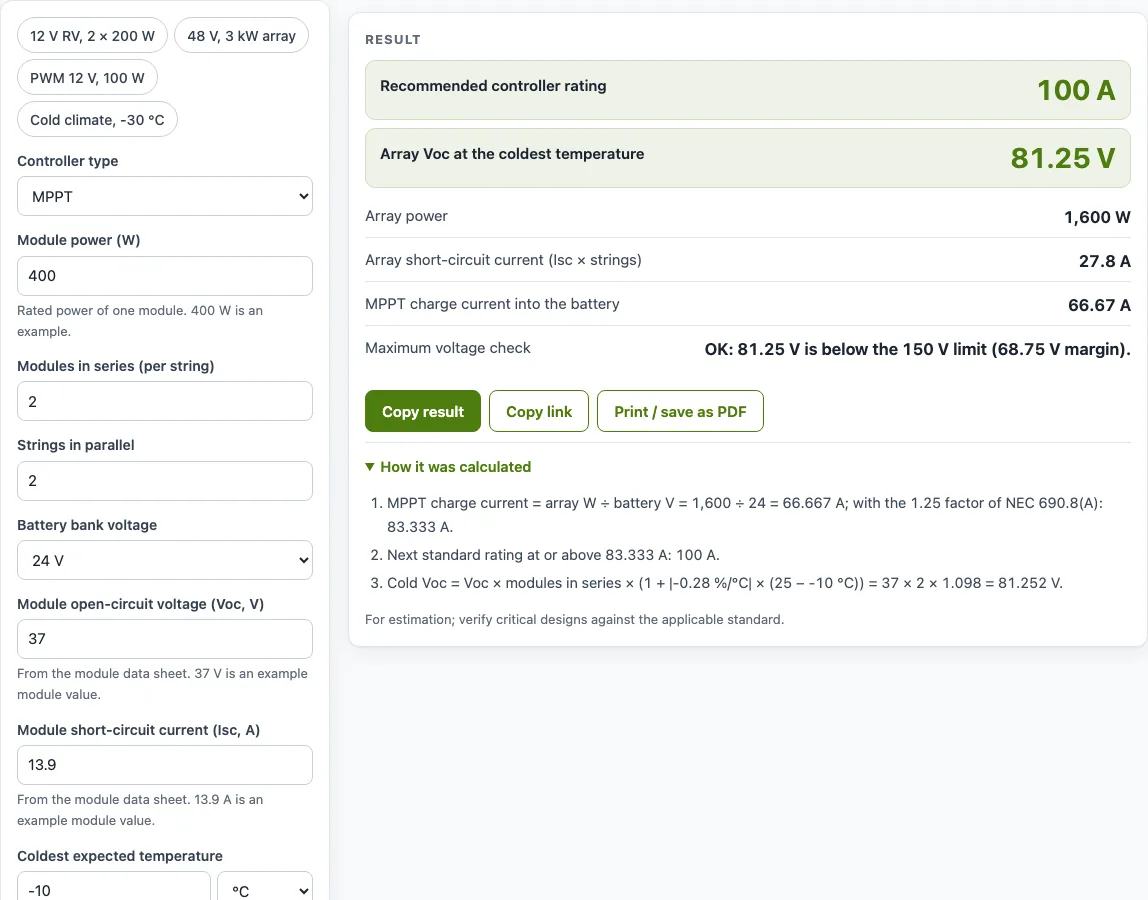
How to use the Solar Charge Controller Calculator
- Choose the Controller type: MPPT or PWM.
- Enter the Module power (W). This is the rated power of one module. The 400 W example is the CertainTeed CTM10400HC11-06 module.
- Enter the Modules in series (per string) and the Strings in parallel.
- Select the Battery bank voltage: 12 V, 24 V or 48 V.
- Enter the Module open-circuit voltage (Voc, V) and the Module short-circuit current (Isc, A) from your module data sheet. The 37.04 V and 13.79 A examples are from the CertainTeed CTM10400HC11-06 data sheet.
- Enter the Coldest expected temperature and choose °C or °F.
- Open More options. Enter the Voc temperature coefficient (%/°C) from the module data sheet, which is a negative number. Then enter the Controller maximum PV input voltage (V) from the controller data sheet.
- Read the result rows that appear for your mode, and check any warnings.
- Open How it was calculated to see the formula with your own numbers.
The example buttons above the form load sample setups, such as 12 V RV, 48 V, 2.4 kW array and Cold climate. Reset restores the starting example. Copy result copies the result lines with a link. Copy link saves every input in the page address, so the same calculation reopens later. Print / save as PDF prints the inputs, results, steps and date.
What size charge controller do I need?
A charge controller must be rated for the current your array can deliver to the battery. The calculator gives that minimum current; makers sell different size steps, so pick a controller rated at or above it.
For example, four 400 W modules wired as 2 in series by 2 in parallel on a 24 V battery give 1,600 W ÷ 24 V = 66.7 A for an MPPT controller. Multiplied by 1.25, that is about 83.3 A, so look for a controller rated at 83.3 A or more.
How do I calculate charge controller size?
For an MPPT controller, divide the array power in watts by the battery voltage, then multiply by 1.25. For a PWM controller, multiply the array short-circuit current (Isc) by the number of parallel strings, then multiply by 1.25. The 1.25 factor is the one NEC 690.8(A) applies to PV circuit currents, to allow for sunlight above the rated test conditions; for the MPPT output it is used here as a margin.
The calculator applies these formulas automatically. Its “How it was calculated” section shows each step with your numbers. For instance, a PWM setup with one 400 W module (Isc 13.79 A) on a 24 V battery needs at least 13.79 × 1.25 = 17.2 A.
MPPT vs PWM: which do I need?
Choose MPPT when your array voltage is higher than the battery voltage, because MPPT controllers convert the extra voltage down to the battery. Choose PWM when the panel voltage suits the battery voltage, because PWM controllers connect the modules straight to the battery. A PWM setup needs a module or series string designed for the battery system, and the calculator warns you if it does not match.
An MPPT controller also needs the array Voc to be above the battery voltage before it can start charging. If the calculator shows that warning, add modules in series.
Why does cold weather matter for a charge controller?
Cold weather raises a module’s open-circuit voltage, so the array can exceed the controller’s maximum PV input voltage on the coldest day, even if it is safe in summer. The calculator estimates the coldest array Voc with this formula: Voc × modules in series × (1 + |temperature coefficient| × (25 − Tmin)). The result must stay below the controller’s maximum PV input voltage.
In the example with two 37.04 V modules in series at −10 °C and the data sheet’s −0.27 %/°C coefficient, the cold Voc is 81.08 V. That is below a 150 V limit. If your coldest temperature is above 25 °C, the calculator applies no cold correction, so check the lowest temperature your site can reach.
Worked examples
| Input | Result |
|---|---|
| MPPT, 2 in series × 2 strings of 400 W modules, 24 V battery | rated 83.33 A or more, cold Voc 81.08 V |
| MPPT, 1 in series × 2 strings of 400 W modules, 12 V battery | rated 83.33 A or more, cold Voc 39.54 V |
| MPPT, 3 in series × 2 strings of 400 W modules, 48 V battery | rated 62.5 A or more, cold Voc 121.6 V |
| PWM, 1 in series × 1 strings of 400 W modules, 24 V battery | rated 17.24 A or more, cold Voc 40.54 V |
| MPPT, 4 in series × 1 strings of 400 W modules, 24 V battery | rated 83.33 A or more, cold Voc 170.2 V |
Calculated by the tool above with these values.
Frequently asked questions
Can I use this calculator for a 12 V RV system?
Yes. Select 12 V as the battery bank voltage and enter your own module and controller values. The 12 V RV example button loads a sample setup you can change.
What does the 1.25 factor do?
It adds a margin to the calculated current, the same 125 % that NEC 690.8(A) applies to PV circuits. The result is the minimum controller current rating; choose a model rated at least that much.
What if no controller I can buy is large enough?
Split the array across several controllers, each sized for its own part of the array with this calculator.
Do I need to know the temperature coefficient?
Yes, for the cold-weather check. Find the Voc temperature coefficient on the module data sheet under More options. It is a negative number for silicon modules, so check the sign on the data sheet.
Is the result accurate enough for a final installation?
The result is an estimate. Verify critical designs against the applicable standard before you buy equipment or install a system.
What happens if the array voltage is too high for the controller?
The controller can be damaged. That is why the calculator checks the array’s open-circuit voltage at your coldest temperature against the controller’s maximum PV input voltage: rewire with fewer modules in series or choose a controller with a higher voltage limit if the check fails.
Related tools
- Solar wire size calculator: use it to size the cable between your array, controller and battery.
- Solar panel calculator: use it to plan your panel layout before choosing a controller.
- Solar panel output calculator: use it to estimate how much power your panels produce.
- Solar battery size calculator: use it to size the battery bank the controller will charge.
- Battery charging time calculator: use it to estimate how long it takes to recharge a battery.
- All solar and battery calculators: use it to browse the full set of tools.
Sources
- EC&M, Calculating current ratings of photovoltaic modules: NEC 690.8 125 % and 156 % factors
- CertainTeed CTM10400HC11-06 data sheet: example 400 W module (Voc 37.04 V, Isc 13.79 A, Vmp 31.01 V, −0.27 %/°C Voc, 1722 × 1134 mm)