Solar Panel Angle Calculator (Tilt)
Enter your latitude to get the best solar panel tilt angle for the whole year, each season or a chosen date.
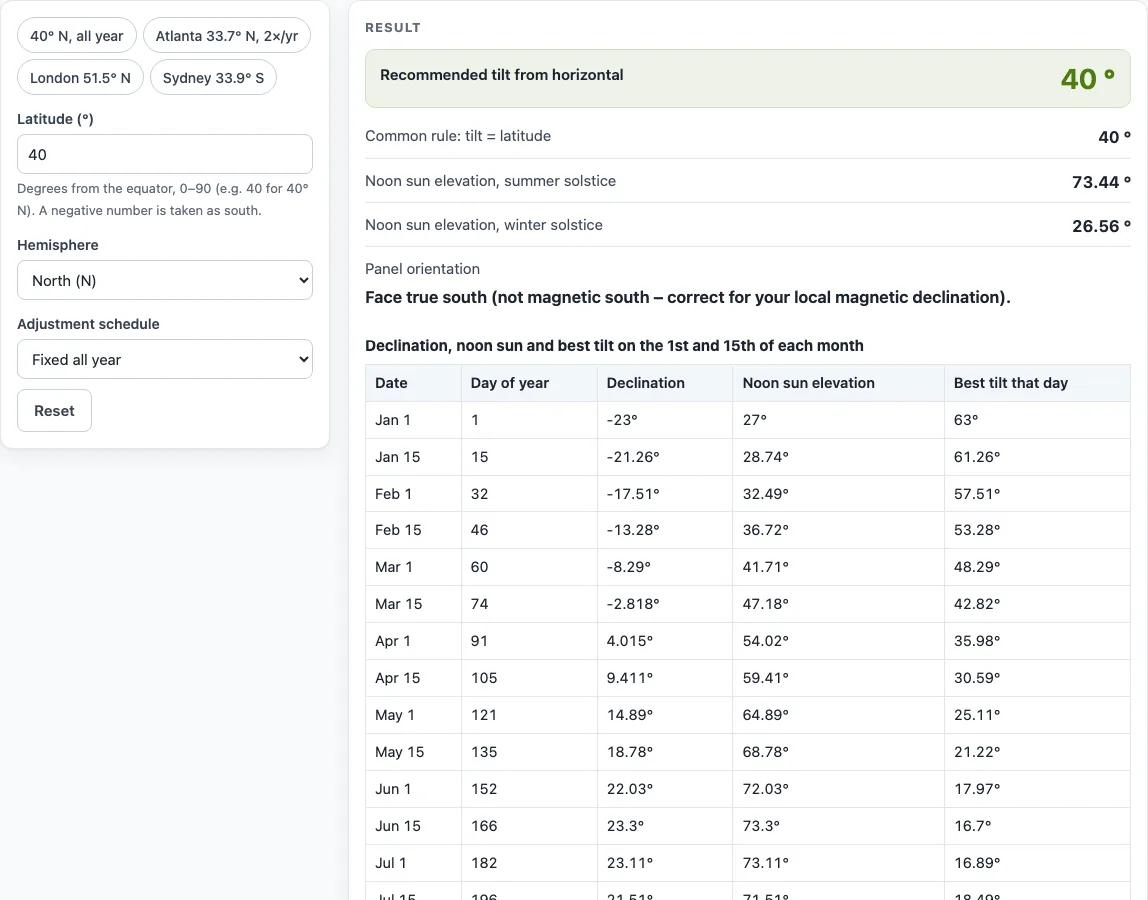
How to use the solar panel angle calculator
- Enter your latitude in Latitude (°). Use degrees from the equator, from 0 to 90, for example 40 for 40° N. A negative number is taken as south.
- Pick your Hemisphere: North (N) or South (S).
- Choose an Adjustment schedule: Fixed all year, Adjust 2 times a year, Adjust 4 times a year, or Best tilt for one date.
- If the Month and Day of month fields appear, enter the date you want to check. These fields only show in some modes.
- Read the result rows. Only the rows that apply to your chosen mode appear. Note the recommended tilt from horizontal and the panel orientation.
- Read any warning shown with the result, then open “How it was calculated” to see the formula with your own numbers.
Use a phone compass or map to find your latitude if you do not know it; whole degrees are accurate enough. The example buttons above the form fill in 40° N (fixed all year), Atlanta 33.7° N (2 times a year), London 51.5° N, and Sydney 33.9° S. Reset restores the starting example.
Copy result copies the result lines with a link. Copy link stores every input in the page address, so the same calculation reopens later. Print / save as PDF produces a file with the inputs, results, steps and the date.
What is the best angle for solar panels?
For a panel that stays at one angle all year, the common rule is a tilt equal to your latitude. The calculator also estimates the tilt that maximises average noon-sun alignment over the year, which is a geometric estimate and not an irradiance simulation.
The sun’s height at noon changes through the year. Solar declination, the angle of the sun north or south of the equator, is given by Cooper’s formula (1969): δ = 23.45° × sin(360/365 × (284 + n)), where n is the day of the year. It reaches about +23.45° at the June solstice in the northern hemisphere and about −23.45° at the December solstice.
Because the noon sun is high in summer and low in winter, one fixed tilt cannot face it directly all year. At 40° N, the noon sun reaches 73.45° elevation at the June solstice and 26.55° at the December solstice. A panel tilted at 16.55° faces the summer noon sun directly, and one tilted at 63.45° faces the winter noon sun directly. A fixed 40° tilt sits between these two. Flatter settings suit summer and steeper settings suit winter, which is why seasonal adjustment at 2 or 4 times a year is available.
How do you calculate solar panel tilt angle?
Find the solar declination for the day, then subtract it from your latitude and take the absolute value. The result is the tilt from horizontal at which the panel faces the noon sun directly on that day.
- Find the day of the year, n. For example, 1 January is day 1.
- Work out δ = 23.45° × sin(360/365 × (284 + n)).
- Calculate the tilt: tilt = |latitude − δ|.
- Check the noon sun elevation: 90° − tilt.
At 40° N on the June solstice, δ is about 23.45°, so the tilt is |40 − 23.45| = 16.55°. On the December solstice, δ is about −23.45°, so the tilt is |40 − (−23.45)| = 63.45°. The noon sun elevations are then 73.45° and 26.55°, which match the figures above.
Worked examples
| Input | Result |
|---|---|
| 40° N, Fixed all year | tilt 40°. Face true south (not magnetic south – correct for your local magnetic declination). |
| 33.7° N, Adjust 2 times a year | summer 19°, winter 48.5° |
| 51.5° N, Fixed all year | tilt 51.5°. Face true south (not magnetic south – correct for your local magnetic declination). |
| 33.9° S, Fixed all year | tilt 33.9°. Face true north (not magnetic north – correct for your local magnetic declination). |
| 40° N, Best tilt for one date | tilt 63.4°. Face true south (not magnetic south – correct for your local magnetic declination). |
Calculated by the tool above with these values.
Frequently asked questions
Should solar panels face south?
In the northern hemisphere, panels face true south. In the southern hemisphere, they face true north. True north and true south differ from magnetic north and magnetic south by your local magnetic declination, so correct for that before you set the panel.
How often should I adjust solar panel tilt?
The calculator offers fixed all year, 2 times a year, and 4 times a year. Adjusting 2 times a year means a flatter tilt in summer and a steeper tilt in winter. At Atlanta (33.7° N), the calculator gives a summer tilt of 19° and a winter tilt of 48.5°. A fixed tilt needs no adjusting but matches the sun less closely in some seasons.
What is the best tilt if I can only set one angle?
Set the tilt equal to your latitude, which is the common rule. At 40° N that is 40°, and at 51.5° N it is 51.5°. Face the panel true south in the northern hemisphere or true north in the southern hemisphere.
Why is the tilt so small near the equator?
Close to the equator, the noon sun passes on both sides of the zenith during the year, so the best tilt is small. A tilt of at least a few degrees is still needed so that rain can wash the panel.
What do the polar circle and pole-side warnings mean?
Above 66.5°, the sun does not rise or does not set for part of the year, so the noon-sun figures are only a rough guide. On some dates the noon sun is on the pole side of the zenith, and the panel would need to face the opposite way. The orientation result shows this.
Can I use the results in a quote or report?
Yes. Results, charts and printouts may be used freely in commercial work such as quotes, proposals, reports and service records, with no attribution needed. Every result carries the note “For estimation; verify critical designs against the applicable standard.”
Related tools
- Solar panel calculator for a general starting point before you size or position your panels.
- Solar panel output calculator when you want to estimate how much energy your panels could produce.
- Solar charge controller calculator when you are choosing a controller for your panel array.
- Solar battery size calculator when you need to size a battery bank for your system.
- Solar wire size calculator when you are choosing cable between panels, controller and battery.
- All solar and battery calculators to browse every tool on the site.
Sources
- PVEducation, Declination angle: Cooper’s declination formula