Solar Panel Orientation Calculator (Direction and Tilt)
Enter your latitude, the panel tilt and the direction it faces to see how much of the best possible yearly sunlight it collects.
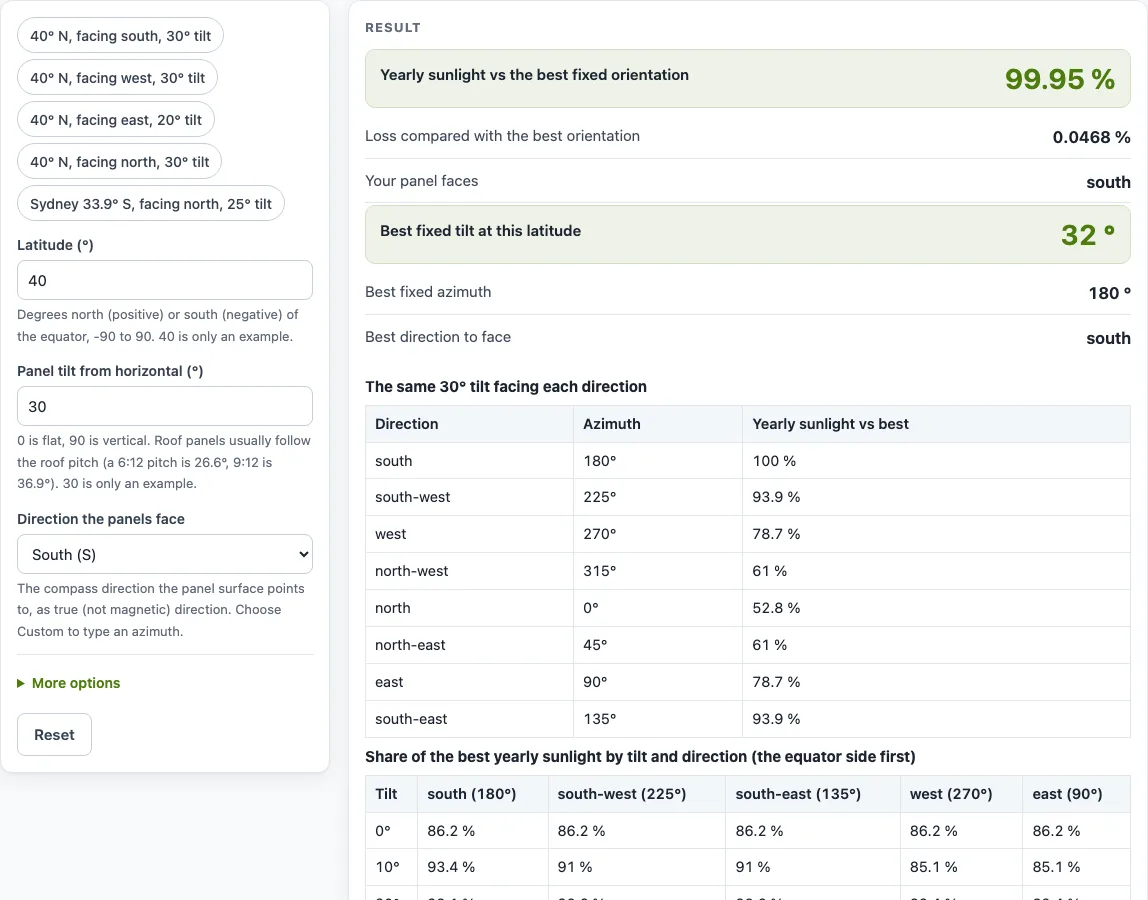
How to use the solar panel orientation calculator
- Enter your latitude in the “Latitude (°)” box. Use positive numbers north of the equator and negative numbers south of it, for example -33.9 for Sydney.
- Enter the panel tilt in “Panel tilt from horizontal (°)”. 0 is flat and 90 is vertical. For a roof panel, use the roof pitch: a 6:12 pitch is 26.6°.
- Open the “Direction the panels face” drop-down and choose a compass point such as South (S). The direction is true, not magnetic.
- For an exact bearing, choose Custom. The “Azimuth (°, clockwise from north)” box then appears. Enter 0 for north, 90 for east, 180 for south and 270 for west.
- Open More options and set “Diffuse light (% of direct beam)” if your site is cloudier than the 10 % clear-sky default.
- Read the result rows. “Yearly sunlight vs the best fixed orientation” and “Loss compared with the best orientation” show the comparison. “Best fixed tilt at this latitude” and “Best fixed azimuth” show the target setting.
- Check any warning messages and the two tables under the result: the same tilt facing each of eight directions, and the tilt-by-direction matrix.
The example buttons above the form load five ready-made cases, including 40° N facing south at 30° tilt. Under the result, “How it was calculated” lists every step with your numbers. Copy result copies the result lines and a link. Copy link stores all your inputs in the page address, so the calculation reopens later. Print / save as PDF includes inputs, results, steps and the date. Reset restores the starting example.
Which direction should solar panels face?
In the northern hemisphere, a fixed panel generally does best facing true south. In the southern hemisphere it does best facing true north. The sun sits on the equator side of the panel for most of the year, so the panel receives its light more squarely. “True” means geographic north, not magnetic north, so correct for magnetic declination at your site.
What is solar panel azimuth?
Azimuth is the compass direction a panel faces, measured clockwise from true north: 0 is north, 90 is east, 180 is south and 270 is west. Together with tilt, the angle from horizontal, it fully defines a panel’s orientation. A panel facing south-east, for example, has an azimuth of 135°.
How much do east or west facing solar panels lose?
At 40° N with a 30° tilt, an east or west facing panel gets about 78.7 % of the yearly sunlight that a south-facing panel gets. The sun strikes an east or west panel at a more oblique angle for much of the day, so less of its beam lands square on the surface. Tilt and latitude change the exact figure, so check your own setup.
Do north-facing solar panels work?
A north-facing panel in the northern hemisphere still produces power, but it is the weakest choice. At 40° N with a 30° tilt, it gets about 52.8 % of the best yearly sunlight, because the sun is mostly to the south. North only becomes the best direction in the southern hemisphere.
What tilt and direction is best for my latitude?
Use the Best fixed tilt and Best fixed azimuth results for your latitude. At 40° N, the best fixed panel is tilted 32° and faces south. A flat panel there gets about 86 % of the best, while a 45° tilt facing south gets about 97.6 %. In this model the best fixed tilt comes out a few degrees below the latitude: 32° at 40° N.
Does orientation matter in the southern hemisphere?
Yes, and the direction is reversed. At 33.9° S (Sydney), the best fixed panel faces north at about 28°. A 25° panel facing north gets about 99.9 % of the best, but facing south it gets only about 63 %. Near the equator, direction matters little because the sun passes both north and south of the panel.
Worked examples
| Input | Result |
|---|---|
| latitude 40°, tilt 30°, facing south | 100 % of the best fixed orientation (best: 32° tilt facing south) |
| latitude 40°, tilt 30°, facing west | 78.7 % of the best fixed orientation (best: 32° tilt facing south) |
| latitude 40°, tilt 20°, facing east | 82.4 % of the best fixed orientation (best: 32° tilt facing south) |
| latitude -33.9°, tilt 25°, facing north | 99.9 % of the best fixed orientation (best: 28° tilt facing north) |
Calculated by the tool above with these values.
Frequently asked questions
Is the result in kWh?
No. Results are percentages of the best fixed orientation, not energy amounts. For kilowatt-hours, use the solar panel output calculator.
Does the calculator include weather or shading?
No. It uses a clear-sky model and does not account for weather, shading, ground reflection, temperature or inverter losses. For exact yearly energy, use a weather-based simulator such as NREL PVWatts.
What should I change if my site is cloudy?
Raise the “Diffuse light (% of direct beam)” value under More options. More diffuse light raises the share of east, west and north-facing panels and favours flatter panels.
Why does the calculator warn about a tilt below 5°?
A nearly flat panel lets rain pool and dirt build up instead of washing off, so leave some tilt unless the mounting forces a flat layout.
Should I use true south or magnetic south?
Use true (geographic) south. A compass points to magnetic north, which differs from true north by the magnetic declination at your site, so correct the compass reading by that amount before you set the direction of a mounting frame.
How do I convert a roof pitch to a tilt in degrees?
Tilt is the arctangent of rise over run. A 4:12 pitch is 18.4°, 6:12 is 26.6°, 8:12 is 33.7°, 9:12 is 36.9° and 12:12 is 45°. Enter that number as the panel tilt to score a roof-mounted array that follows the roof.
Can I use the results in a quote or report?
Yes. Results, charts and printouts can be used freely in commercial work such as quotes, proposals, reports and service records, and no attribution is needed.
Related tools
- Solar panel angle calculator: use it to work out the tilt angle for a panel mount when direction is already fixed.
- Solar position calculator: use it to see where the sun is in the sky at a given time and place.
- Solar panel output calculator: use it to estimate energy output in kWh once you have chosen an orientation.
- Solar payback calculator: use it to estimate how long a solar installation takes to pay back its cost.
- Solar string calculator: use it to plan how panels are wired together in series and parallel.
- All solar and battery calculators: use it to browse every calculator on the site.
Sources
- NOAA Global Monitoring Laboratory, General Solar Position Calculations: sun elevation and azimuth through the day and year
- PVEducation, Air mass: direct intensity 1.353 × 0.7^(AM^0.678) kW/m² and global light about 1.1 × the direct beam (used for the default 10 % diffuse share)