Solar String Calculator (Series and Parallel)
Enter the panel data sheet values, your coldest temperature and the device input limits to find the longest string and the layouts that fit.
The Solar String Calculator works out how many solar panels you can wire in series and in parallel in one string. It uses your panel’s data-sheet values, your site’s coldest temperature, and the maximum input voltage of your inverter or charge controller. It returns the most panels allowed in one series string. With the optional inputs, it also shows the fewest panels for an MPPT range, the most strings in parallel, and the layouts that fit a total panel count.
The calculator runs in your browser, is free, and needs no sign-up. Nothing you enter is uploaded. Use it to check a layout during planning, then confirm the final design against the rules that apply where you install.
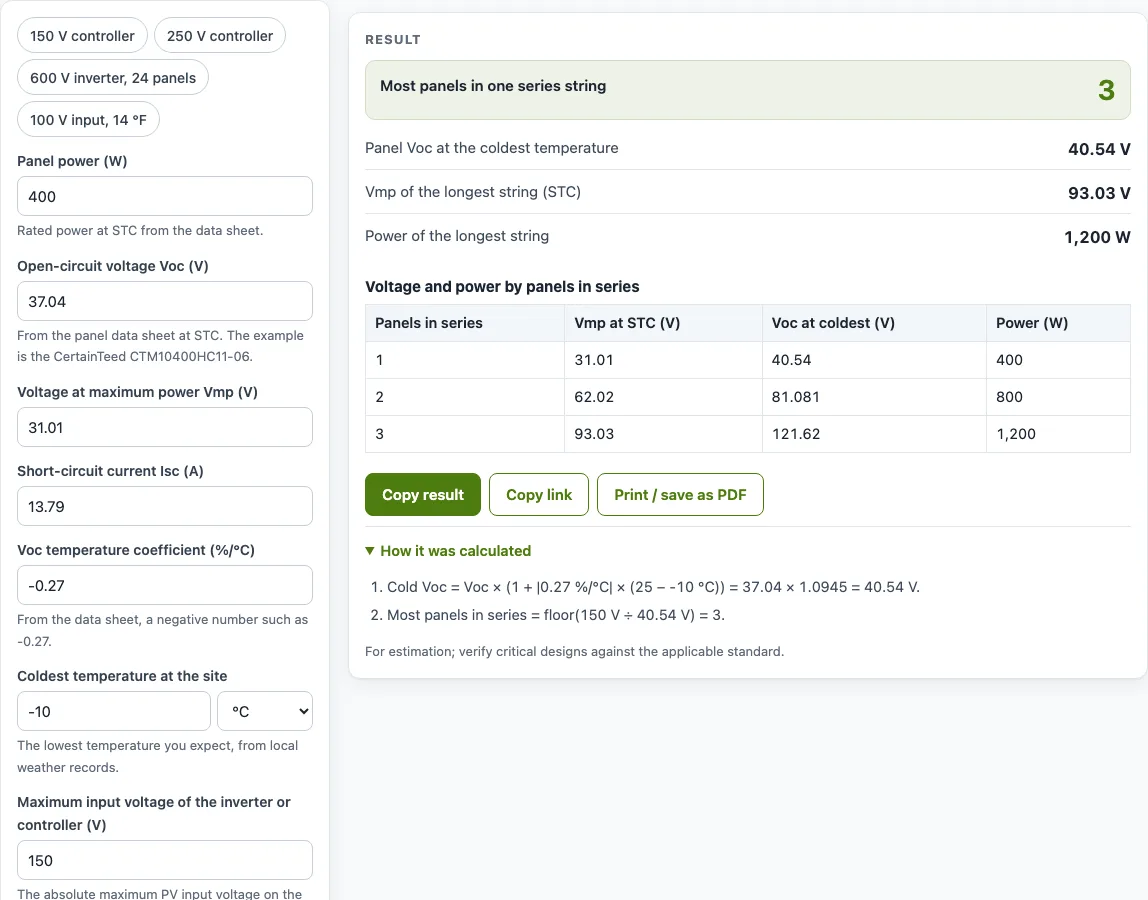
How to use the Solar String Calculator
- Type the panel’s rated power in Panel power (W).
- Enter Open-circuit voltage Voc (V) and Voltage at maximum power Vmp (V) from the panel data sheet.
- Enter Short-circuit current Isc (A) from the same data sheet.
- Enter Voc temperature coefficient (%/°C) as a negative number, such as -0.27.
- Enter Coldest temperature at the site and choose °C or °F.
- Enter Maximum input voltage of the inverter or controller (V) from the device data sheet.
- Optional: enter Total number of panels – optional to see which series × parallel layouts fit.
- Optional: under More options, fill in the device’s maximum PV input current, the MPPT minimum voltage, the hottest panel temperature, and the Vmp temperature coefficient.
- Read the result rows and any warnings. Check the steps under How it was calculated.
The example buttons above the form fill in sample values: a 150 V controller, a 250 V controller, a 600 V inverter with 24 panels, and a 100 V input with a 14 °F site. Copy link saves every input in the page address, so the same calculation reopens later. Copy result copies the result lines with a link. Print / save as PDF includes the inputs, results, steps, and date. Reset restores the starting example.
How many solar panels can I put in series?
You can put as many panels in series as the device’s maximum input voltage allows, divided by one panel’s cold open-circuit voltage, rounded down. The limit comes from the controller or inverter, so the answer changes with each device.
Cold Voc = Voc × (1 + |temperature coefficient| × (25 − coldest temperature) ÷ 100). No reduction is applied above 25 °C. For a panel with Voc 37.04 V and a coefficient of −0.27 %/°C at −10 °C, the cold Voc is 40.54 V. A 150 V controller takes 3 panels in series (150 ÷ 40.54 = 3.7), and a 600 V inverter takes 14 (600 ÷ 40.54 = 14.8).
How do you calculate solar panel string size?
Calculate string size in a fixed order: cold Voc first, then the series limit, then the optional checks. The result is the number of panels in one series string, and the parallel count is worked out separately.
- Calculate the cold Voc at the coldest expected temperature.
- Divide the device’s maximum input voltage by the cold Voc, and round down. This gives the most panels in one series string.
- Optional: divide the MPPT minimum voltage by the hot-weather Vmp, and round up. This gives the fewest panels in series. Vmp falls as cells heat up, so hot Vmp = Vmp × (1 − |Vmp coefficient| × (hottest cell temperature − 25) ÷ 100).
- Optional: divide the device’s maximum PV input current by the panel Isc, and round down. This gives the most strings in parallel.
If the fewest-panel figure is higher than the most-panel figure, the panel and device do not fit together in one string. The calculator shows a warning in that case.
Why use the coldest temperature for string sizing?
Use the coldest temperature your site can reach because open-circuit voltage rises as panels get colder. The coldest expected temperature gives the highest voltage the string will produce, so it is the value that can break the device limit.
The 25 °C value on the data sheet is the standard test condition. It does not show the voltage on a cold morning. NEC 690.7 requires the maximum system voltage to account for the lowest expected temperature. If the coldest temperature you enter is above 25 °C, the calculator skips the cold correction and uses the data-sheet Voc, and it shows a warning to check that value.
What is the difference between series and parallel solar panels?
In a series string, panel voltages add up and the current stays the same as one panel. In a parallel connection, currents add up and the voltage stays the same as one panel. The calculator follows this rule: panels in series add voltages, and strings in parallel add currents.
Using the example panel, three panels in series give about 93 V at Vmp (3 × 31.01 V) while the short-circuit current stays 13.79 A. Two panels in parallel keep 31.01 V at Vmp, and the short-circuit current doubles to 27.58 A. The Voltage and power by panels in series table shows how the voltage and power change with each added panel. When you enter a total number of panels, a second table, Layouts for N panels, lists the series and parallel combinations that use all of your panels exactly.
Worked examples
| Input | Result |
|---|---|
| Voc 37.04 V (-0.27 %/°C), coldest -10 °C, device max 150 V | cold Voc 40.54 V, up to 3 panels in series |
| Voc 37.04 V (-0.27 %/°C), coldest -10 °C, device max 600 V | cold Voc 40.54 V, up to 14 panels in series |
| Voc 37.04 V (-0.27 %/°C), coldest 14 °F, device max 100 V | cold Voc 40.54 V, up to 2 panels in series |
Calculated by the tool above with these values.
Frequently asked questions
Does the calculator upload my panel or site data?
No. The calculator runs in your browser, and nothing is uploaded. You do not need to create an account to use it.
What does “No exact series × parallel layout” mean?
None of the layouts for the total panel count you entered divides evenly while staying within the limits. Try a different total, such as one that splits into equal strings.
Why does the tool warn about the temperature coefficient sign?
Silicon panels lose voltage as they heat up, so their Voc coefficient is negative. If you enter a positive number, check the sign on the data sheet before you trust the result.
Do I need the Vmp temperature coefficient?
Only for the optional minimum-string check against the MPPT range. The maximum string length uses the Voc coefficient and the coldest temperature alone.
Which temperature do I use if my site never freezes?
Enter the lowest temperature your site can reach, even if it is above 0 °C. If that temperature is above 25 °C, the calculator uses the data-sheet Voc without a cold correction and shows a warning.
Can I use the results in a quote or proposal?
Yes. You can use the results in commercial work, such as quotes, proposals, reports, and service records. No attribution is needed.
Related tools
- Solar charge controller calculator: use it to size the controller that the string must match.
- Solar wire size calculator: use it to choose cable for the string runs and the array output.
- Inverter size calculator: use it to match the inverter’s rating to your total array power.
- Solar panel output calculator: use it to estimate the energy a panel array produces.
- All solar and battery calculators: use it to browse every calculator on the site.
Sources
- CertainTeed CTM10400HC11-06 data sheet: example 400 W module (Voc 37.04 V, Isc 13.79 A, Vmp 31.01 V, −0.27 %/°C Voc, 1722 × 1134 mm)
- NEC (NFPA 70) 690.7: the maximum PV system voltage is set with the lowest expected temperature (the section number is cited here; the code text and tables are not reproduced)
- Cold-temperature correction of Voc with the data-sheet coefficient: PVEducation, Effect of temperature