Solar Wire Size Calculator
Enter the circuit current, voltage and run length to get the wire gauge for a solar string, charge controller or battery cable.
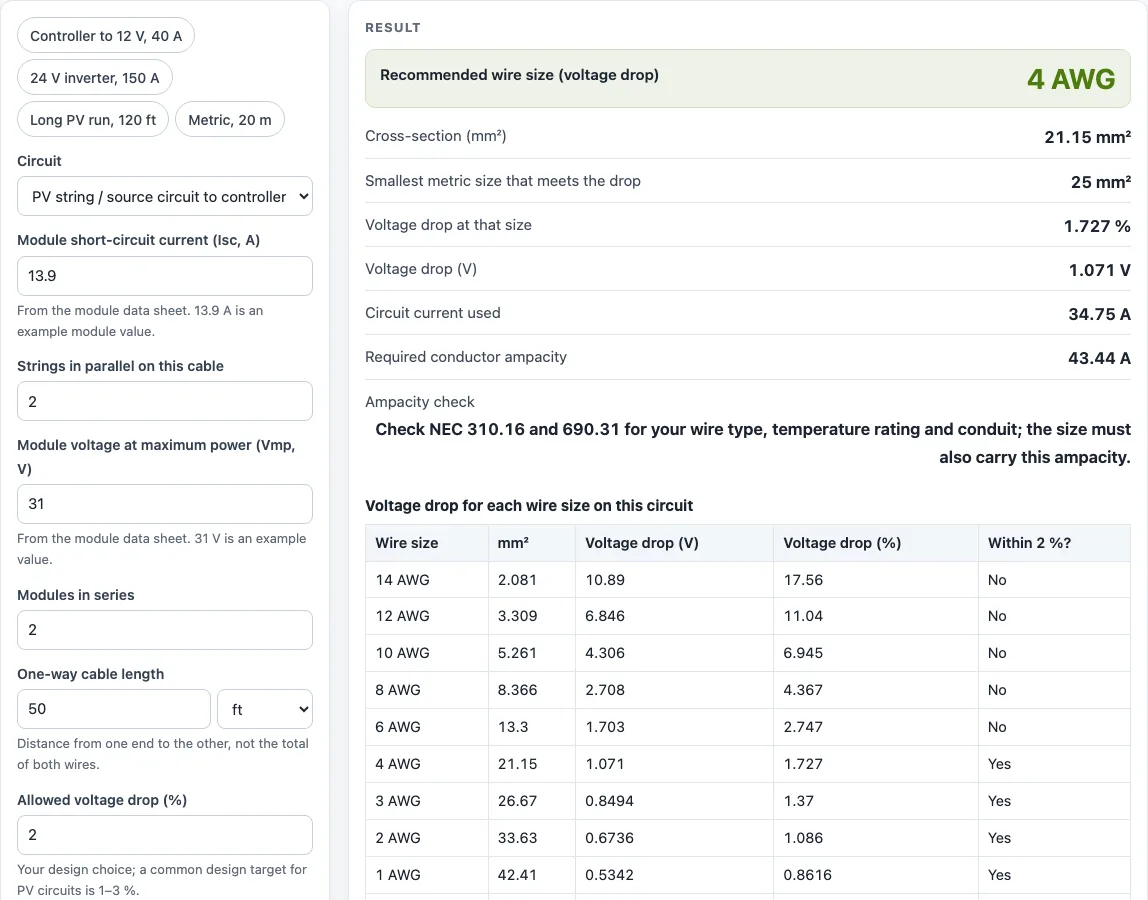
How to use the Solar wire size calculator
- Choose a value for Circuit: PV string / source circuit to controller, Charge controller to battery, or Battery to inverter. The form shows the inputs that apply to that circuit.
- For PV circuits, enter Module short-circuit current (Isc, A) from the module data sheet and Strings in parallel on this cable. Where shown, also enter Module voltage at maximum power (Vmp, V) and Modules in series.
- For battery-side circuits, enter Circuit current (A), which is the maximum continuous current including any safety margin your design needs, and Battery / system voltage (V).
- Enter One-way cable length and pick ft or m. Measure one way only, not both wires together.
- Set Allowed voltage drop (%). The default is 2 %. A common design target for PV circuits is 1–3 %.
- Choose Conductor material: Copper or Aluminum.
- Under More options, set Conductor temperature for resistance to 75 °C or 90 °C.
- Read the results: Recommended wire size (voltage drop), Required conductor ampacity and Ampacity check. Confirm the ampacity in NEC 310.16 and 690.31 before you buy.
The example buttons above the form load preset cases, including Controller to 12 V, 40 A, 24 V inverter, 150 A, Long PV run, 120 ft, Metric and 20 m. Under the result, Copy result copies the result lines with a link, and Copy link stores every input in the page address so the same calculation reopens later. Print / save as PDF produces a printout with inputs, results, steps and the date. Reset restores the starting example.
What size wire do I need for solar panels?
The wire size depends on two things: the current the cable carries and the voltage drop you allow over its length. Choose the smallest size that has enough ampacity for the circuit current and keeps the drop within your limit. Longer runs need thicker wire, even at the same current, because resistance grows with length.
For example, a PV run of 50 ft at 2 % allowed drop needs 4 AWG, while 120 ft at the same drop needs 1/0 AWG (53.48 mm²).
How do I calculate solar cable size?
Work in three steps. First, find the circuit current. For a PV circuit, multiply the module Isc by the number of parallel strings and by 1.25. Second, calculate voltage drop with VD = 2 × L × I × R, where L is the one-way length, I is the current, and R is the conductor resistance for its material and temperature. Third, pick the smallest size whose drop is within your allowed percentage. The calculator does the second and third steps and shows its working under “How it was calculated.”
Worked example: two strings of two CertainTeed CTM10400HC11-06 modules (Isc 13.79 A, Vmp 31.01 V on the data sheet), so a string voltage of 62.02 V, 50 ft one way and a 2 % allowed drop. The circuit current is 13.79 × 2 × 1.25 = 34.48 A. The required ampacity is 34.48 × 1.25 = 43.1 A. The result is 4 AWG with a 1.71 % drop.
What is the 156 % rule for PV wire?
The 156 % rule is two 125 % factors applied together. NEC 690.8(A)(1) sets the PV source and output circuit current as module Isc × parallel strings × 1.25. NEC 690.8(B) then requires the conductor to carry 125 % of that circuit current, which gives 1.25 × 1.25 = 1.5625, or 156 % of the total Isc.
In the worked example above, the total Isc is 27.58 A (13.79 A × 2 strings), and 156 % of that is 43.1 A, the required ampacity. The calculator shows this value, but the wire must still pass the ampacity check in NEC 310.16 and 690.31.
What size wire from charge controller to battery?
Use a short, thick cable. Battery-side cables carry high current at low voltage, so even a small drop takes a large share of the voltage, and the wire must be heavy to keep the drop low. Enter the circuit current, the battery or system voltage, the cable length and your allowed drop, and select Charge controller to battery.
For example, 6 ft one way at 2 % gives 6 AWG (13.3 mm²) with a 1.96 % drop. For the battery-to-inverter cable, 5 ft at 2 % gives 4 AWG (21.15 mm²) with a 1.93 % drop. Keep the run as short as practical, because the drop grows with length.
Worked examples
| Input | Result |
|---|---|
| PV string / source circuit to controller, 50 ft one way, 2 % drop | 4 AWG (21.15 mm²), 1.71 % drop |
| Charge controller to battery, 6 ft one way, 2 % drop | 6 AWG (13.3 mm²), 1.96 % drop |
| Battery to inverter, 5 ft one way, 2 % drop | 4 AWG (21.15 mm²), 1.93 % drop |
| PV string / source circuit to controller, 120 ft one way, 2 % drop | 1/0 AWG (53.48 mm²), 1.63 % drop |
| PV string / source circuit to controller, 20 m one way, 2 % drop | 1 AWG (42.41 mm²), 1.94 % drop |
Calculated by the tool above with these values.
Frequently asked questions
Is this solar wire size calculator free to use?
Yes. It runs in your browser, needs no sign-up, and nothing you enter is uploaded.
Can I use the results in a quote or report?
Yes. Results, charts and printouts can be used freely in commercial work such as quotes, proposals, reports and service records, and no attribution is needed.
Does the calculator confirm that my wire can carry the current?
No. It sizes the wire by voltage drop only and does not reproduce ampacity tables. Check the Ampacity check result, then confirm the conductor’s ampacity in NEC 310.16 and 690.31 for its type, temperature and conduit. For PV source circuits, use wire listed for the purpose, such as PV wire or USE-2.
What if the result is larger than 4/0 AWG?
Check the lugs, terminals and bending radius of your equipment, or consider parallel conductors. You can also shorten the run or raise the system voltage to reduce the required size.
Why does the calculator warn about my allowed voltage drop?
The allowed drop is your design choice. A value above the common 1–3 % PV design target triggers a warning. Low-voltage circuits lose a larger share of their voltage in cable, so compare the result with what your equipment can tolerate.
Related tools
- Solar charge controller calculator: use it to choose a controller rating before you size the cable from the controller to the battery.
- Inverter size calculator: use it to find the inverter size that sets the current on the battery-to-inverter cable.
- Solar panel calculator: use it to work out how many panels your system needs.
- Solar battery size calculator: use it to size the battery bank that the battery-side cables connect to.
- Solar panel output calculator: use it to estimate module output, which feeds the Isc and current values you enter here.
- All solar and battery calculators: use it to browse every calculator on the site.
Sources
- EC&M, Calculating current ratings of photovoltaic modules: NEC 690.8 125 % and 156 % factors
- NBS Handbook 100, Copper Wire Tables and Handbook 109, Aluminum Wire Tables: conductor resistivity
- CertainTeed CTM10400HC11-06 data sheet: example 400 W module (Voc 37.04 V, Isc 13.79 A, Vmp 31.01 V, −0.27 %/°C Voc, 1722 × 1134 mm)